
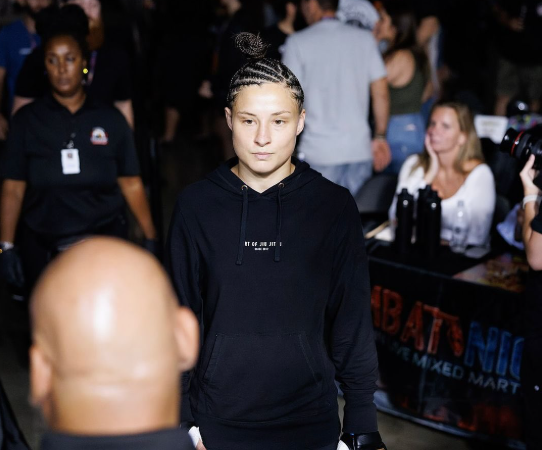
For Iasmim Casser, the path to MMA started with one unexpected introduction.
“It started when a guy that’s now one of my best friends came into the gym I trained Muay Thai at to show some Jiu Jitsu, since some people there fought MMA too,” she said. “That’s when the seed was planted, and I started watching MMA when Ronda Rousey was destroying everyone. I watched her nasty armbars and got interested in grappling. Although there were not a lot of big MMA gyms around.”
Before discovering grappling, Casser’s base was in Muay Thai. “I started in Muay Thai at 16 years old, had quite a bit of amateur fights in the local and national scene for about two years,” she said. “Went to Thailand for the last one. Then I started fighting MMA, and that led me to start training Jiu-Jitsu, which I fell in love with and had a whole career in it from white to black belt, competing and being successful in hundreds of matches at the highest level of competition. And then I went back to MMA fighting.”
Casser grew up far from Brazil’s major fight hubs. “I am from the middle of nowhere in the very south of Brazil,” she said. “Not your typical picture of Brazil—no nice beaches and tan people, and all that fun stuff. Our people from my state have their own traditions and culture, very different than the rest. Life can be harsh there, but people are as real as it gets. There’s not a lot to do, or many opportunities of getting anywhere with fighting there.”
She was eighteen when she started fighting MMA and began learning Jiu-Jitsu, “initially with the simple intention of defending myself against grappling,” she said. “But I found out grappling was natural to me, and I fell in love with BJJ.”
One pivotal moment came when she attended a seminar that changed her life. “I went to a seminar of the people that made me look at Jiu Jitsu differently, and made my eyes shine every time I watched them: the Mendes brothers,” she recalled. “I had no expectations of being at the seminar other than seeing the men themselves. I didn’t know anything about Jiu-Jitsu. Long story short, they invited me to move to Costa Mesa, CA, and be part of Art of Jiu-Jitsu’s competition team. Said that I was gonna be a world champion and that I could use that to build my grappling background for MMA, and by the time I got the black belt, I would still be young enough to finish what I started in MMA.”
Years later, Casser would find herself at one of America’s top MMA teams. “In 2023, I was invited to be a sparring partner to Tracy Cortez against a tall girl and grappler like me,” she said. “So I came over for a month and noticed that everyone at the gym had really good wrestling, and they had a good structure for the fight team. I had never wrestled before, and during my whole career in Jiu Jitsu, I was a guard player, and had never ever gone for a takedown in my whole life. So Fight Ready could be the perfect place for me to finally learn that. So I moved to AZ and joined Fight Ready.”
Training under Santino DeFranco has provided a new sense of purpose and structure. “That hard work can take you anywhere you want,” she said when asked what she’s learned from the veterans around her.
Her list of inspirations reveals how deeply martial arts have shaped her life. “Initially, Ronda Rousey was the one who made me pay attention to MMA, and created the desire in my heart to become an MMA fighter,” she said. “As I got more into martial arts, I started looking into the GOATs of all martial arts. Crazy enough, I looked up to Guilherme and Rafael Mendes the most. That’s before I even thought I could ever leave my city with fighting, let alone my country, and becoming a pro or winning worlds under AOJ. Maybe even crazier than that, I also admired and looked up to Mackenzie Dern. Turns out she is now my best friend. We used to train together in California with Jason Parillo, and lived about 5 minutes from each other. Out of all the people I didn’t get to meet, Muhammad Ali is the one I admire the most. It brings tears to my eyes to think about his story and his heart.”
When asked to describe her fighting style, Casser doesn’t hesitate to be honest. “I would say, random,” she laughed. “It depends on how I feel that day. As I progress and get more comfortable with MMA, every fight I feel like I’m very different and want to try out different stuff.”
What separates her from other fighters, she believes, is her adaptability and toughness. “I think it is my ability to adapt and find a way to win—the willingness to do whatever it takes, even if it’s something unconventional,” she said. “Aside from that, I feel like my one superpower is the fact that I really don’t care about getting hit or hurt. I literally don’t feel anything. I guess I owe that to having come from a hostile place and a very tough and violent childhood. Sometimes I get hit really hard, and people say that I am hurt, and I laugh inside.”
Casser’s goals for the near future are as clear as they are ambitious. “Get a couple more wins at the beginning of the year,” she said. “Get on Contender Series and get into the UFC.”
But the deeper meaning behind fighting runs beyond competition or accomplishment. “That I am way more powerful than I thought my whole life,” she said when asked what she’s learned about herself through fighting. “And I am very far from getting to my full potential still. The possibilities are endless for what you can do; this goes way beyond fighting.”
As for why she fights — and who she fights for — Casser’s answer comes from the heart.
“I fight because it challenges me to tap into the depths of who I am, and figure myself out in a way that nothing else could,” she said. “I would have never found out who I really am and got rid of most of the layers of unnecessary limiting stuff in my brain, and have found this never-ending journey to unattainable perfection that martial arts provide. I fight for myself, my family, and all the people that might be touched or inspired, even if just a little tiny bit by my journey.”
