
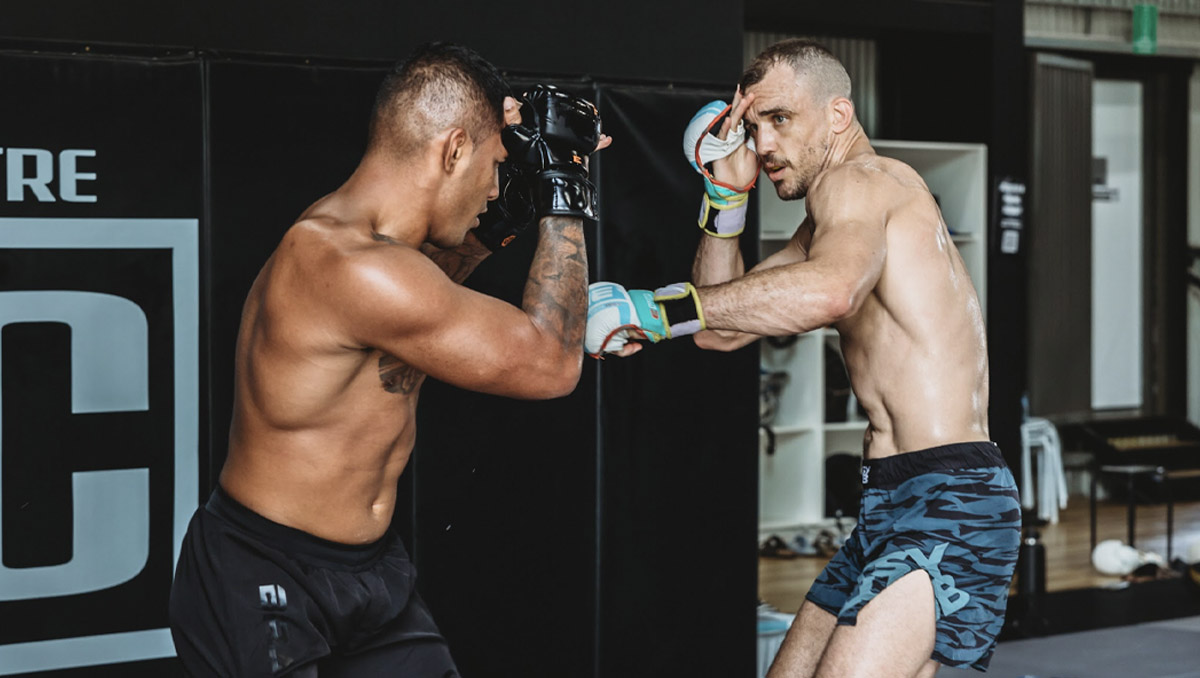
Ben Johnston (5-1)
Middleweight – 35 Years Old – The Fight Centre Brisbane
Most stories in combat sports follow a recognisable shape. A fighter climbs, faces setbacks, keeps going and eventually gets their shot. Ben Johnston’s story follows a different shape entirely. He climbed, got his shot regionally, won it, retired, became a coach, built a life outside the cage – and then, out of nowhere, got the call that put him on the biggest stage MMA has to offer.
Johnston, nicknamed “The Blade,” is a Logan product through and through. A born-and-bred figure from Meadowbrook who co-founded The Fight Centre Brisbane with his close friend James Jarvie back in 2014, Johnston has been one of the most recognisable and respected faces of Queensland combat sports for over a decade. His background spans Muay Thai, boxing, Brazilian jiu-jitsu and MMA – and across all of those disciplines he has shown the same qualities: technical excellence, a finishing instinct, and the kind of work ethic that makes him someone other fighters follow. He earned a WBC Muay Thai world title. He trained under Eugene Bareman at City Kickboxing. He was invited to assist Israel Adesanya in preparation for his rematch against Alex Pereira. He is, by any measure, a genuine combat sports craftsman.
His MMA career was short by conventional standards but strong in every way that matters. A professional record of 5-1, with every single win coming inside the distance – four submissions and a knockout reflecting a finishing approach he brought from his Muay Thai and jiu-jitsu backgrounds. He opened his pro run against quality opposition, building through the Eternal MMA ranks before the fight that defined his regional career: the Eternal MMA Middleweight Championship bout against John Martin Fraser at Eternal MMA 83, won by rear-naked choke at 1:15 of the second round. As champion, Johnston commanded enormous respect within the Australian MMA community, both for what he had done in the cage and for the role he played outside it – mentoring young fighters, running a gym, and setting a standard that his team at The Fight Center Brisbane looked up to.
And then he retired. A serious shoulder injury sustained during wrestling contributed to the decision, and by 2024, he had vacated the title, stepped back from competition, and committed himself fully to coaching. That looked like the end of the competitive chapter, and by all accounts, Johnston had accepted it. He got married, started a family, had a child on the way, and had settled into the next phase of his life.
Then the UFC called. When Darcy Vendy – Johnston’s own protégé and the fighter who had won the Eternal title after Johnston vacated it – was unable to take the UFC Perth booking, Johnston was identified as the most qualified alternative. The call came, he said yes, and what had seemed like a closed door swung open into something none of the Australian MMA community had expected to see: Ben Johnston in the UFC, making his debut at 35 years old, two years removed from competition, on home soil in Perth.
The story has resonated so strongly because it is not just a sporting comeback – it is a human one. Johnston himself has been open about the personal layers involved: the return to competition after genuinely moving on, the challenge of getting his body ready for the demands of real fight preparation after two years as a coach rather than a competitor, and doing it all while his wife is expecting their first child. Those details give the story a texture that goes beyond wins and losses. He has described the challenge not as rediscovering desire – the connection to fighting never left, it simply shifted into coaching others – but rather as letting his body catch up to where his mind already was.
The intriguing part for those watching from a purely competitive standpoint is what version of Johnston shows up in the cage against Wes Schultz. The skills are real – four submission wins tell you everything about the grappling quality, and a career built across multiple striking disciplines speaks for itself. The question of ring rust after two years away is a legitimate one, and Johnston himself acknowledged needing to approach this camp differently, with more deliberate recovery and lower-intensity days than he would have managed in his prime. Whether those two years can be bridged in a single camp is the fascinating question that Perth will answer. What is not in doubt is that the fighter who won the Eternal MMA Middleweight Championship and helped train one of the country’s best gyms is a different, more complete martial artist than the one who was called “just another regional fighter.” If the comeback works, it would be one of the most compelling Australian MMA stories of 2026. If it falls short, it is still a story worth telling – about a man who gave everything to the sport, gave just as much back through coaching, and then answered the phone when the biggest call of his career came two years after he thought the calls had stopped.
