
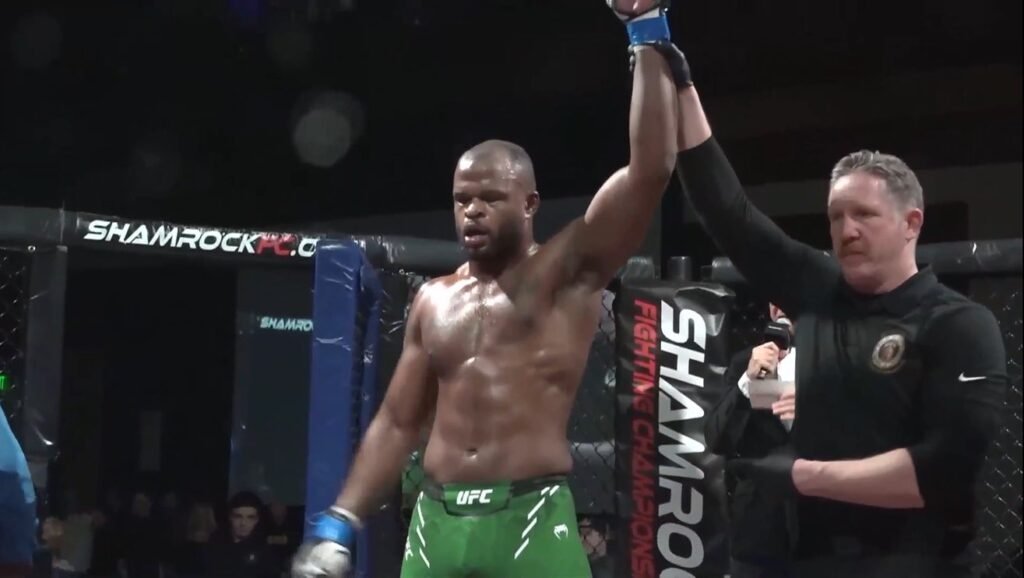
The UFC’s favorite thing to do lately is bringing in ex-Bellator guys. Christian Edwards isn’t at all a surprise to me, considering he is a light-heavyweight.
Edwards was a homegrown Bellator prospect, spending the first four years of his career with the promotion and fighting there eight times. Early on, he was viewed as a potential future star at light heavyweight. Strong early performances, combined with his connection to Jon Jones and the Jackson Wink MMA Academy camp, created real hype around him.
Edwards was a homegrown Bellator prospect, spending the first four years of his career with the promotion and fighting there eight times. Early on, he was viewed as a potential future star at light heavyweight. With his early performance and being teammates with Jon Jones, it put some hype behind him. When Edwards first came to Bellator, he was fighting bums. He was basically casting out the fishing line and reeling in miners. It wasn’t until he reeled in a big tuna and it was too much for him. When he fought Ben “Big Tuna” Parrish, he was knocked out in under a minute.
Since then, Edwards hasn’t looked as confident as he did during the early stages of his career. At one point, his move to heavyweight even raised questions about his long-term commitment and direction in the sport. To his credit, though, he has bounced back over the last two years, going 3-1 in his past four fights. His lone loss during that stretch came by decision to Luke Fernandez, who has since made it to the UFC himself.
It’s a bit surprising that there isn’t more buzz around Edwards making his UFC debut. At 6-foot-5, he’s an athletic light heavyweight with legitimate tools and high-level training. At the same time, the lack of excitement is understandable because he simply hasn’t lived up to the early expectations. The losses on his résumé are rough. He was knocked out by Parrish, controlled by Grant Neal, gassed and submitted by Rakim Cleveland with a relatively basic front choke, and dropped an underwhelming decision to Fernandez.
Lately, Edwards has leaned more into his wrestling game. He has solid takedowns along the cage and can physically overwhelm opponents in clinch situations, although he does telegraph his entries at times. A lot of his wrestling success comes from simply being the bigger, stronger athlete, and that won’t consistently work against higher-level UFC competition.
On the ground, Edwards is capable enough to exploit weaker grapplers. He does good damage with ground-and-pound and transitions well between dominant positions. However, his control isn’t always reliable, and stronger wrestlers could pose serious issues for him. Grant Neal, for example, had extended stretches of top control against him. Edwards is at least active off his back, using wrist control and his long frame to threaten submissions and create scrambles.
Offensively, Edwards is dangerous because of his length and variety. He throws clean straight punches, mixes in kicks well, and moves laterally better than most fighters his size. One thing he does especially well is building combinations and finishing them with head kicks. Earlier in his career, his versatility made him a difficult matchup. He attacked from different angles, blended punches and kicks together naturally, and did nasty work in the clinch with elbows and Thai knees. He also had a strong sense for catching opponents as they exited exchanges, often cutting them off with hooks or head kicks.
That said, he’s gone away from the clinch more in recent years. Whether that’s due to durability concerns or a strategic shift, it has removed one of the more dangerous aspects of his game.
Defensively, Edwards leaves too many openings due to mental lapses. When he throws combinations, he’s often vulnerable on the retreat because he doesn’t bring his hands back to position quickly enough. He also drops his hands when throwing kicks or disengaging from the clinch. Against bigger, more powerful UFC light heavyweights, those mistakes are going to be punished.
Overall, I don’t mind the UFC signing Edwards at all. He’s still a young, athletic light heavyweight with legitimate skills and physical upside. The losses are concerning, but he arguably owns better wins and more proven experience than many fighters entering the UFC at middleweight and above.
At this stage, though, Edwards still looks more like a fringe top-25 light heavyweight than a future contender. He has enough ability to stick around the middle tier of the division for a while. Still, unless the defensive issues improve significantly, it’s hard to see him breaking beyond that level.
A quick prediction: Bukauskas by decision. I don’t see Edwards coming in on short notice and beating a veteran like Bukauskas.
