
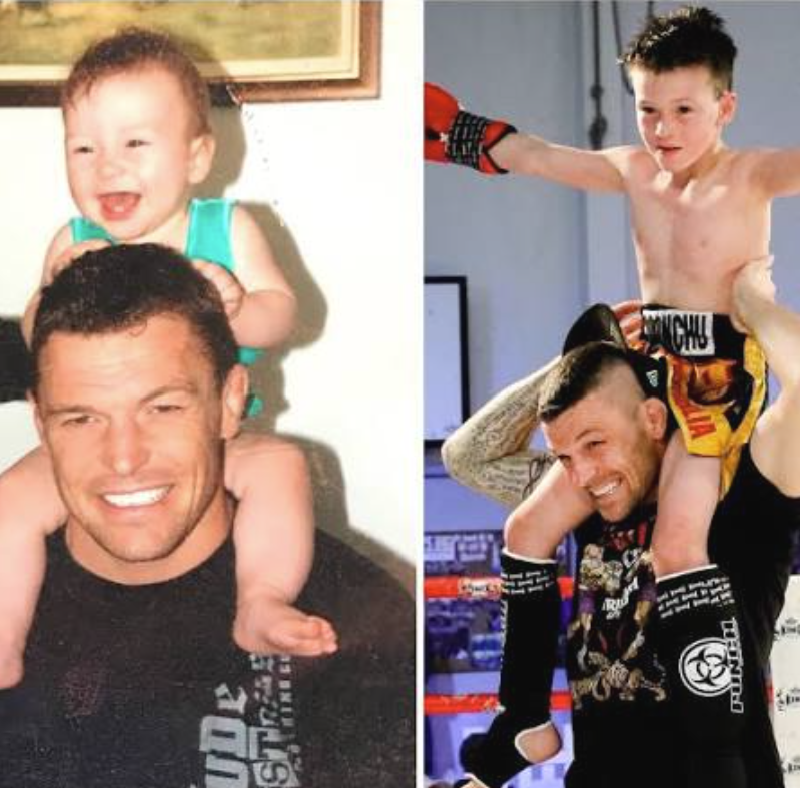
There is a particular kind of pressure that comes from a surname. Ask any child of a champion who has ever had to walk into a stadium carrying a name that already means something to a room full of strangers, yet Jesse-James Parr (1-0 AM) has carried that weight since before he could even properly walk.
Son of Muay Thai icon John Wayne Parr, a ten-time world champion with 149 fights and 99 wins, and by any measure Australian combat sports royalty. His mother, Angie Parr, is a two-time Muay Thai champion in her own right and co-owner of the family’s Boonchu Gym. His sister Jasmine is building her own name in professional boxing, and now, at nineteen years old, Jesse is stepping into MMA, and doing so with a level of composure that belies his age.
What stands out to me after interviewing Jesse is not the skill set or the bloodline; it’s his maturity. This is a young fighter who talks about brain health with the same seriousness as a veteran, who isn’t afraid of losing and wants to take the hardest fights he can get. A young fighter who, when asked how he wants to be remembered, reaches only for his own legacy.
Sleeping Through the Wins
Jesse’s introduction to combat sports did not come with a decision; it came with the furniture. He grew up inside Boonchu, immersed in a household where training was simply what happened every day. He has home videos of himself throwing kicks and punches while still in nappies, teep-kicking into his first steps and learning the rhythm of pad work with his father before he could even talk.
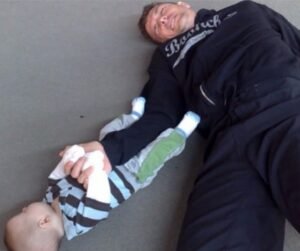
As a young child, Jesse was taken to Cage Muay Thai promotions to watch his father fight, and by his own admission he usually couldn’t stay awake. He would fall asleep in the back, waking up to check who had won. It is a small, human detail that says something about how ordinary fighting felt inside the family. Jesse has said that his parents never pushed him into the sport; they simply asked if he wanted to go to training. And he never stopped saying yes, drawn in by watching the UFC and kickboxing, and thinking his father looked cool doing what he did. It was only later, watching old highlight reels, that the full scale of what his father had achieved actually landed on him.
His first competitive fight came in Muay Thai at age eight. Around that time, his parents settled on a ring name for him: the “Mini Gunslinger”, a nod to his father’s own nickname “The Gunslinger”. The name stuck until Jesse grew taller than his dad, at which point the family dropped the “Mini”. He has said his parents chose his given name deliberately; they loved Western and cowboy imagery, and between John Wayne and Jesse-James, the gunslinger theme was always going to find its way into the next generation.
Influences Outside the Family
Ask Jesse who inspired him beyond his parents, and two names come up instantly: Georges St. Pierre and Anderson Silva. In Muay Thai, it is Saenchai and Buakaw, the latter forever tied to a classic fight against his own father. But Jesse is quick to point out that his real, day-to-day idols were never far away. Training alongside his parents every day made them the standard he measured himself against long before he knew who else was out there.
Switching to the Enemy Team
For a family built on Muay Thai, jiu-jitsu was, as Jesse puts it, the arch-nemesis. It arrived almost by accident during a stretch in his early teens when he had stepped away from training entirely. His mother took up jiu-jitsu after retiring from Muay Thai and encouraged him to try it with her.
He hated it initially. Grappling felt strange to him, an awkward, almost forced closeness that he was not used to after years of striking. It took discovering the more playful, technical side of the art, the sweeps, the scrambles, what he calls the “ninja stuff”, for it all to click, and once it did, he fell hard. He began competing and found himself winning, eventually reaching Fusion Fighting Championship, regarded as one of the best places in the country to test jiu-jitsu at a high level.
His father needed convincing – John Wayne initially wished his son had stayed purely on the striking path, but the two found a way to make it fun together, rolling on mats set up at home during the pandemic lockdowns. Jesse is adamant his father would have been a serious threat on the ground had he trained it seriously himself. Eight years deep into jiu-jitsu before he seriously moved back to striking, Jesse says it was that grappling foundation that eventually pulled him back toward Muay Thai, and from there forward the idea of combining everything into mixed martial arts.
Wrestling filled in the remaining gap. Jesse built that side of his game through aggressive training camps in the United States during high school world championship trips, and through six weeks of coaching from Frankie Stevenson, son of TUF 2 winner Joe “Daddy” Stevenson, who had travelled to Australia to work with him.
Building an MMA Game Without an MMA Coach
One of the more unconventional aspects of Jesse’s setup is that he does not train mixed martial arts in the traditional, blended sense. Striking happens every morning with his father, in a small glove, chin down, hands up system his dad more or less invented through caged Muay Thai. Jiu-jitsu and ground work occur separately in the afternoon with his own coach, a fourth-degree black belt who has fought in MMA. The two disciplines rarely mix in a single session.
Jesse points to Ilia Topuria as validation for the approach: a fighter who trains boxing in one session and jiu-jitsu in another rather than blending everything into generic MMA training and sparring. The main adjustment he has had to make mentally, rather than technically, is positional safety. In jiu-jitsu, being on your back in a closed guard is a winning position; however, in MMA, the same posture reads as losing to judges and audiences alike, carrying the very real risk of getting hit while grounded or controlled to a losing decision. Adapting his instincts to that different scoring reality, while still carrying over the aggression that defines his wrestling and jiu-jitsu, has been the real work of the transition.
Pressure as a Privilege
If there’s one thread that defines Jesse’s mentality, it’s how deliberate he ponders his own longevity. He sparred with the specific goal of protecting his long-term health well before it became public conversation around his father. He limits hard sparring to twice/week, prioritizing speed, combinations, and cardio over absorbing needless damage, a response to watching the toll a 150-fight Muay Thai career took on his father, including Tourette-like symptoms that John Wayne has since spoken about publicly.
One of Jesse’s biggest fears is CTE, and he is precisely building his career to be short and efficient rather than long and grinding. His target is specific: he wants to be retired, financially comfortable, and a champion by his mid-thirties, rather than fighting into his forties like many in his father’s generation. He has spoken about pressure as something close to a privilege, a force that will either make him or break him, and one that early exposure at junior Muay Thai and jiu-jitsu competitions has taught him to carry.
That same discipline shapes his career roadmap. Rather than rushing towards the UFC, Jesse plans to take as few amateur fights as possible before turning professional in the Australian scene. His manager, Ash Belcastro, who also manages Alexander Volkanovski, has counselled patience and the UFC only once he is genuinely ready to dominate it, not simply once eligible. It’s a plan built by someone who has clearly thought past the hype of a single viral moment.
The maturity extends to his personal life too. Jesse does not drink, smoke, or gamble, choosing instead to center his teenage years entirely around training and nutrition. He spoke about the sacrifices made in that choice, accepting it as the price of the life he’s trying to build for himself and his future family.

Seeing the Bill Come Due
Perhaps the most striking thing Jesse discussed, particularly in his interview with Mitchell Tinley from the Australian MMA publication ahead of his debut, was his father’s health. He described it as a brutal sport, noting that his father, now fifty, is not the same person he was twenty years ago because of fighting. He talked about the strange grief of watching someone who is, by public reputation, an aggressive ten-time champion, and privately a man who has paid a real cost for that career. Jesse has called it a love-hate relationship: proud of what the sport has given his family, but honest about what it has taken from his father.
That honesty is not incidental. It is a rare thing for someone his age to be candid about the realities of fighting and the impact it had on his father, in public, without flinching from it. It also explains, more than any single training decision, why Jesse remains committed to a shorter, smarter career rather than following the path his father took.
Processing Loss, a 33-Second Victorious Debut, and Eternal 110
Jesse has talked about overcoming a childhood tendency toward perfectionism and being a poor loser, learning instead to train defeat as feedback rather than identity. A loss in his framing does not define a fighter. Dwelling on it does more damage than the loss itself.
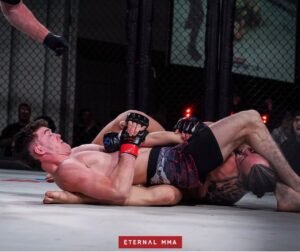
That mindset was not tested in his MMA debut. Jesse finished his first amateur MMA bout in 33 seconds, a result that surprised even him and sent his profile into a different stratosphere overnight, with support flooding in from across the sports world.
He steps into Eternal 110 for his second amateur bout on September 12 against 2-0 Ash Bristow, carrying the hype that debut created, but talks about the matchup in measured terms: an even fight against a good striker, one he respects, and one he intends to beat to prove he belongs at this level. There is no trash talk in how he discusses it – he would rather let his performance on the night do the talking.
The Weight Behind the Weight Cut
Jesse’s approach to weight management mirrors the same long-term thinking that shapes everything else. Walking around at 71 or 72 kg, he is undergoing his first properly controlled cut to a fight weight of 65.6kg, working with a nutritionist through gradual portion and carbohydrate reduction, rather than an aggressive final-week starve. He aims to drop only two to three kilograms in fight week itself, and stresses that scientific, careful rehydration is critical to any potential successes on fight day.
A Dynasty in the Making
Jesse is not the only Parr carrying the family name into combat sport. His mother, Angie Parr, a two-time Muay Thai champion in her own right, co-owns Boonchu, and was the one who introduced Jesse to jiu-jitsu after her own retirement from striking, effectively setting his entire MMA game in motion without either of them realising it at the time.
His older sister Jasmine has built her own name in professional boxing, taking a completely different route through the family’s combat sport gene pool. Jesse has said he constantly encourages her to try MMA, believing she has more than enough talent for it, though she has stayed in boxing. By his own account, Jasmine was genuinely excellent at jiu-jitsu as a junior competitor, close to earning her blue belt before stepping away from the sport entirely to focus on boxing instead.
His younger sister Jemma is still working out her own path, training in both jiu-jitsu and Muay Thai with more fights of her own on the horizon. The family, half joking, is still waiting to see which discipline she eventually commits to.
It amounts to a genuine combat sports dynasty under one roof, each family member finding a slightly different discipline to make their own while it all still ties back to the same gym and same surname. When Jesse talks about wanting the Parr name to mean something in combat sports long after his own career ends, it becomes clear he means the whole family, not just himself.
Where He Wants This to End
Jesse-James Parr’s ultimate goal is not simply a UFC contract – it is to beat the very best in the world, become pound-for-pound number one, and cement the Parr name as combat sports royalty in the mould of Georges St. Pierre. He wants to be remembered as one of the greatest fighters Australia has ever produced, and for the Parr legacy to be what people remember him for as much as any single win.
He plans to get there quietly, by his own standards. No trash talk. No manufactured feuds. Just performance, family, and a level head that, at nineteen, already understands more about the cost of the sport than some fighters twice his age. That combination, talent inherited and wisdom earned early, is exactly why Jesse belongs in this series alongside the likes of George Mangos, Harry Webb, and Marwan Rahiki. He is not just the next Gunslinger, but may yet be the clearest example yet of what the next generation of Australian and New Zealand combat sport may look like.
This article draws on a direct interview conducted between myself and Jesse, along with comments Jesse made in a separate interview with the Australian MMA Podcast ahead of his Eternal 108 debut against Lakota Daniel.
