
Road To UFC Review | Season 5 Opening Rounds: Day 1

Road to UFC Day 1 is officially in the books, and as always, the tournament delivered a mix of standout performances, brutal finishes, and a few surprises along the way.
Several prospects took a major step toward earning UFC contracts, while others may have seen their momentum come to an end. In the following thread, I’ll break down the action fight by fight, share my thoughts on the biggest performances, and discuss what could be next for the standout names from the event. Once again this year, finishes earn fighters points toward their potential contracts, meaning stoppages could significantly boost a winner’s final standing with the UFC.
Bantamweight — Ryuho Miyaguchi (-230) vs Chungreng Koren (+195)
Our morning started with the bantamweight bracket. Short-notice replacement Chungreng Koren was looking to make the most of his opportunity after his initial RTU run ended due to contractual issues last year. Sadly, his fight week didn’t begin as planned, as the former Matrix Fight Night champion missed weight by a wide margin at weigh-ins. As a result, Koren would not accumulate points toward a potential contract, even with a win.
His opponent, Japan’s Ryuho Miyaguchi, still accepted the fight, looking to boost his own contract chances. Koren was the lone Indian fighter on this year’s RTU roster, while Miyaguchi was the first of several Japanese athletes competing in the tournament.
Right away, the strengths of both fighters became evident. In the striking department, it was all Miyaguchi, who used sharp jabs, low kicks, and ripping body shots. On the other side, Koren showcased solid wrestling acumen, grinding in the clinch against the cage and scoring a nice slam late in Round 1.
Miyaguchi dropped Koren momentarily at the start of Round 2 with a beautiful counter, but he got too aggressive afterwards and was tagged repeatedly, getting badly hurt in return. Koren pounced with ground-and-pound for more than three minutes without finding the finish, repeatedly taking Miyaguchi down and battering him with punches and elbows while the Japanese fighter was visibly in a world of hurt.
Koren eventually shifted to the grappling department, where he looked superior, locking in a rear-naked choke without hooks near the end of Round 2 to secure the tap, the win, and the first professional loss of Miyaguchi’s career.
Koren looked really good, despite being dropped. He showcased resilience, a strong pace despite the weight miss, and excellent finishing instincts. Miyaguchi didn’t look out of place, but the damage from Koren’s shots was simply too much to recover from.
India has been searching for a breakout MMA star for years. Is Koren that guy? Probably not. Still, he’s likely the best fighter the country currently has, and a UFC contract would continue helping the sport grow there.
Result: Chungreng Koren (8-2) defeats Ryuho Miyaguchi (7-1) via R2 submission (rear-naked choke)
Featherweight — Jin Aoi (+165) vs YoungJae Song (-190)
Our first featherweight matchup of the year featured experienced Japanese veteran Jin Aoi, already a Road to UFC alum after dropping a split decision last year. Since then, he had won two straight, notably defending his DEEP featherweight title. Korea’s YoungJae Song was also a RTU veteran, having lost a decision in 2024 before rebounding with three finishes, including a successful Angels FC title defense.
The first thing that stood out was Song’s physicality. He was visibly larger than Aoi. One notable adjustment from Aoi was his willingness to wrestle early, despite usually preferring to strike. He initiated grappling exchanges along the fence and secured takedowns from the opening minutes.
During a scramble back to the feet, Aoi landed a powerful hook that dropped Song, despite not landing perfectly clean. It was a surprising development, considering Aoi isn’t known for punching power. Song did almost nothing in Round 1 besides grabbing the fence, sticking his fingers inside Aoi’s gloves, and getting dropped.
Song opened Round 2 with a knee to the head of a grounded Aoi during a scramble, losing a point from referee Jason Herzog. Despite being dominated for most of the fight, Song eventually landed on top during a takedown exchange, quickly found Aoi’s back, and secured the rear-naked choke midway through the round.
It was honestly a really strong performance from Jin Aoi despite the loss. He looked much improved from his previous RTU appearance, especially in terms of fight IQ and strategy. One small mistake during a takedown exchange ultimately cost him the fight.
On the other hand, this wasn’t a particularly impressive showing from Song, despite the win. He looked lost at times and resorted to fouls early in the bout to escape bad positions. He was fortunate Aoi exposed his neck the way he did, because Song had no answers for the takedowns throughout the fight.
Even in victory, this felt like a stock-down performance for the Korean fighter. Harsh, maybe, but fair.
Result: YoungJae Song (10-1-1) defeats Jin Aoi (16-7-1) via R2 submission (rear-naked choke)
Bantamweight — Ti Haitao (-200) vs Ryo Tajima (+170)
The first Chinese representative on the card, Ti Haitao entered the cage boasting a 94% finish rate as a professional. Originally booked for the tournament last year, a broken nose derailed his plans. Since then, he added three more victories to his résumé, convincing the UFC to bring him back.
His opponent, Ryo Tajima, is the Pancrase bantamweight champion and a dangerous knockout artist himself, making this one of the most promising fights on paper.
Round 1 was mostly a feeling-out process rather than a firefight. Both men had moments late in the round, with Haitao showing interesting striking on the outside while Tajima displayed solid clinch work. Overall, Haitao landed the cleaner shots.
Haitao started mixing things up in Round 2, combining low kicks with level changes and nearly securing takedowns. Tajima defended well, but midway through the round both men began testing each other’s chins in the pocket. A scramble followed where Haitao showcased excellent movement, something we hadn’t really seen from him before.
Haitao did significant damage to Tajima’s calf throughout the round but became somewhat predictable with the kicks, allowing Tajima to secure a takedown. Once again, Haitao scrambled beautifully to reverse position and end up on top while landing ground-and-pound.
Round 3 was clearly Tajima’s best frame. He finished the fight aggressively, letting his hands go while Haitao visibly slowed down. Considering Haitao’s regional résumé is filled with quick finishes, the cardio concerns weren’t exactly shocking.
What I liked most about this fight was seeing the depth of Haitao’s toolbox. He should throw more on the feet because he landed effectively while remaining overly conservative. Still, his striking, defensive awareness on the ground, scrambling ability, and reversals highlighted a complete fighter, rather than a pure striker with nothing else to offer.
His cardio remains questionable, especially over the final minutes. Tajima is better than some of the other bantamweights in this tournament, but I still felt he lost the fight.
And while I was writing this section, the judges rendered a split decision in favor of Tajima.
I strongly disagree with the result. I thought Haitao clearly won Rounds 1 and 2. Tajima really only surged late. He’s solid everywhere but doesn’t particularly excel in any area, which makes him effective, but somewhat unexciting.
Result: Ryo Tajima (11-3) defeats Ti Haitao (18-7) via split decision
Bantamweight — Rabindra Dhant (-800) vs Kimbert Alintozon (+550)
Rabindra Dhant made history this morning as the first Nepalese fighter to compete on Road to UFC. He most recently captured the Matrix Fight Night title against fellow RTU competitor Chungreng Koren. Dhant is an entertaining striker with an entire country behind him, and despite the event taking place in Macau, he received one of the loudest crowd reactions of the day.
On the other side, Kimbert Alintozon stepped in on short notice, and the odds reflected it. He’s been inconsistent throughout his career but remains a scrappy, game fighter.
Dhant towered over Alintozon physically, but the Filipino wasn’t intimidated early. Dhant initially pursued a wrestling-heavy approach, but Alintozon defended the takedowns extremely well. The very first punch Alintozon made visible damage over Dhant’s eyebrow.
Alintozon found early success on the feet with sharp low kicks and good timing, while Dhant constantly threw with bad intentions. The Filipino used his smaller frame effectively to outspeed Dhant throughout most of Round 1 and certainly didn’t look like a +550 underdog.
Round 2 started with Dhant quickly securing mount, and from there the fight completely shifted in his favor. He rained down ground-and-pound while threatening submissions. Alintozon kept moving but continuously exposed his back in the process. Dhant was simply too strong.
Eventually, the Nepalese prospect advanced to full mount and unloaded enough unanswered strikes for the referee to intervene.
Dhant started slowly but looked excellent in the second round. His dominance on the ground may have been aided by the size discrepancy, so it remains to be seen whether he can replicate that success against opponents his own size.
Still, he made a smart adjustment after taking too many clean shots early. As for Alintozon, he lost nothing in defeat, considering how undersized he was. He honestly looks more suited for flyweight.
The UFC will absolutely want Dhant to go far in this tournament considering the crowd support and regional interest he already generates.
Result: Rabindra Dhant (10-1) defeats Kimbert Alintozon (7-4) via R2 TKO
Featherweight — Regezhen (-220) vs Dagilsuren Chagnaadorj (+185)
Another intriguing matchup on paper, Shanghai PI product Regezhen entered Macau riding a four-fight winning streak. Known primarily for his knockout power, he projects as a potential fan favorite if he advances through the tournament.
Across from him stood Mongolian standout Dagilsuren Chagnaadorj, whose only two career losses came against the same opponent. He was one of the few fighters on the card with more decisions than finishes and brought a well-rounded skill set into the cage.
Round 1 was mostly a feeling-out process. Chagnaadorj attempted to wrestle, but Regezhen defended well and consistently returned to his feet. On the feet, Regezhen held the advantage, though he relied heavily on isolated power shots instead of combinations.
We know Regezhen possesses serious power, but Chagnaadorj was too experienced to be caught clean by predictable single strikes. Regezhen attempted to mix in kicks but found little success.
Chagnaadorj entered Round 2 with wrestling clearly in mind, but once again Regezhen’s takedown defense held up. The Mongolian eventually secured top position midway through the round and landed some solid ground-and-pound, but Regezhen stayed active off his back and threatened submissions before returning to his feet.
The Chinese fighter finally began throwing combinations with success while Chagnaadorj’s cardio visibly dipped. Still, Regezhen remained far too patient and low-volume for my liking, despite landing the cleaner strikes.
Chagnaadorj found a second wind in Round 3 and actually outworked Regezhen on the feet while the Chinese fighter looked content to coast. The Mongolian closed the fight strongly with a takedown and a final flurry of ground-and-pound in the closing seconds.
This fight ended up being much closer than expected, largely because Regezhen faded badly in the third round.
Weird fight overall. Regezhen looked like the cleaner and more talented fighter, but Chagnaadorj simply wanted it more. He fought with urgency and determination while Regezhen lacked both.
Regezhen only has himself to blame: poor urgency, low output, and questionable cardio cost him dearly. Chagnaadorj may not win the tournament, but this was a veteran performance through and through.
Result: Dagilsuren Chagnaadorj (11-2) defeats Regezhen (11-2) via split decision
Bantamweight — Yunosuke Minami (+215) vs Kasib Murdoch (-255)
Yunosuke Minami entered the tournament as one of the dark horses. The GLADIATOR champion owns several highlight-reel finishes, but questions remained regarding the level of competition he had faced.
Across from him stood New Zealander Kasib Murdoch, an incredibly experienced fighter both professionally and as an amateur. Murdoch went 10-0 as an amateur with IMMAF success before turning pro and capturing the HEX FS title.
Murdoch’s complete game is often overshadowed by his small stature, which many observers believe could become a problem later in the tournament. Against Minami, however, size wasn’t much of an issue, since the Japanese fighter is also undersized for bantamweight.
Round 1 showcased both fighters’ strengths. Minami clearly won the striking exchanges and even threw more volume than usual. Meanwhile, Murdoch excelled in the wrestling department, controlling long stretches of the fight on the mat.
Murdoch’s style may not always be crowd pleasing, but it works.
Round 2 began with Murdoch immediately wrestling again. While defending a takedown, Minami grabbed the cage, prompting the referee to instantly deduct a point. Harsh perhaps, but justified given how blatant the foul was.
From there, Minami had almost no success getting back to his feet. Murdoch eventually transitioned from pure control to real damage, battering Minami with heavy ground-and-pound while threatening submissions.
Murdoch finished the round extremely strong. It honestly bordered on a 10-8.
Round 3 picked up exactly where the previous round ended. Murdoch secured another takedown and completely overwhelmed Minami, who barely defended himself at times. Commentator Brian Fitzgerald said it best during the broadcast: this was a bullying performance from Murdoch.
The Kiwi eventually locked in a head-and-arm choke to end Minami’s suffering.
Excellent showing from Murdoch. He entered the tournament with the reputation of being a lay-and-pray wrestler lacking finishing instincts, but he completely silenced those criticisms here.
Minami looked good on the feet, but ultimately proved too one-dimensional to seriously threaten an experienced grappler like Murdoch.
Result: Kasib Murdoch (8-0) defeats Yunosuke Minami (6-1) via R3 submission (head-and-arm choke)
Featherweight — Ahejiang Ailinuer (-125) vs GwanWoo Lim (+105)
This was the closest betting line of the day, as bookmakers and bettors genuinely seemed unsure who to favor.
Ahejiang Ailinuer was originally scheduled to compete on RTU last year before an injury forced him out. A Shanghai PI regular, he’s become a familiar name on the Chinese regional scene.
Across from him stood “The Giant” GwanWoo Lim, a massive 6’2” featherweight with only six professional fights. Lim earned this opportunity after a huge upset victory over Yannick Yuji Ephoeviga in his previous outing. Experience versus raw athletic upside was the storyline here.
Ailinuer immediately used Lim’s height against him, securing a textbook takedown early. Lim did well to scramble back up, but Ailinuer relentlessly chained wrestling attempts together and controlled him against the fence.
The Korean had absolutely no answer for the takedown pressure and submission threats. Round 1 was controlled from start to finish by the Chinese fighter.
The first half of Round 2 followed a similar script. Ailinuer repeatedly grounded Lim and used positional control effectively. Eventually, Lim began sprawling more successfully, but defending takedowns alone doesn’t win rounds.
Lim briefly threatened with a bizarre inverted twister-leg triangle hybrid, but sweat caused him to lose the position. Ailinuer attempted to finish the round aggressively with ground-and-pound, but was reversed late in the frame.
Round 3 featured near fouls from both men: Lim flirted with back-of-the-head shots, while Ailinuer nearly landed a knee on a grounded opponent.
The most memorable moment of the round might honestly have been Ailinuer stomping on Lim’s Achilles tendon. Never seen that before.
Ailinuer continued controlling the wrestling exchanges throughout the final round. He didn’t inflict much damage, but comfortably won the control battle.
Nothing about this performance screamed “future tournament winner,” but it was a polished veteran showing. Post-fight, we learned Lim likely injured his knee during the scrambles.
Lim looked completely out of his depth here. He’s a talented striker, but this was simply a terrible stylistic matchup for him. Still, his striking upside is obvious enough that I wouldn’t be surprised to see him receive another opportunity down the line.
Result: Ahejiang Ailinuer (17-3) defeats GwanWoo Lim (5-2) via unanimous decision
Featherweight — George Mangos (-360) vs Yuito Yanagawa (+295)
George Mangos entered the tournament as arguably the most recognizable name in the field thanks to his DWCS appearance last year. Although he lost that fight, the defeat had more to do with the defensive style of his opponent, Radley da Silva, than anything Mangos failed to do offensively.
The UFC clearly liked what they saw enough to bring him back through the RTU route.
His opponent, Yuito Yanagawa, was no pushover either. The Japanese fighter is the Pancrase champion at featherweight and possesses a very composed grappling game.
Mangos immediately got to work in Round 1, aggressively pursuing takedowns from unconventional positions. Yanagawa held his own on the mat and nearly ended the fight midway through the round with a very tight guillotine choke.
Mangos escaped by the skin of his teeth and eventually ended up on top. Grappling with Yanagawa honestly didn’t seem like the safest game plan, considering how active his guard was.
Once the fight returned to the feet, Mangos wasted no time. He landed a beautiful knee to the liver that folded Yanagawa instantly and left him down for several moments.
Mangos fully justified his status as one of the tournament favorites with this performance. He stayed composed during the guillotine scare, recovered immediately, and finished the fight in devastating fashion.
Yanagawa must feel awful, considering how close he came to securing the submission.
Honestly, I think the bracket would have been far more interesting had we gotten Mangos vs. Lim and Ailinuer vs. Yanagawa instead.
Result: George Mangos (9-1) defeats Yuito Yanagawa (8-2) via R1 KO
Showcase Featherweight Bout — Xie Bin (-600) vs Yudi Cahyadi (+450)
Will this finally be the moment Xie Bin earns a UFC contract?
The Shanghai PI representative has become one of the matchmakers’ favorite names for Road to UFC cards. This marked his fourth RTU appearance, not even counting a previous Dana White’s Contender Series fight.
Xie Bin is a balanced fighter with wins spread fairly evenly between knockouts, submissions, and decisions. Across from him stood Indonesia’s Yudi Cahyadi, the lone Indonesian representative in this year’s tournament, and the reigning One Pride champion.
The fight played out exactly how the odds suggested it would. Xie Bin consistently outstruck Cahyadi before landing a beautiful one-two combination directly on the orbital bone, likely breaking it.
At this point, around 20% of Xie Bin’s professional fights have essentially been UFC auditions through RTU or DWCS. This knockout may finally earn him a contract.
Do I think he’ll find major success inside the UFC? Probably not. But the UFC values finishes, and Xie Bin consistently delivers them.
Result: Xie Bin (15-6) defeats Yudi Cahyadi (8-3) via R1 KO
UFC Lightweight Bout — Rongzhu (-4000) vs Victor Martinez (+1600)
I won’t spend much time on the main event since it was a UFC fight and not really the type of matchup we usually cover at Prospect Vault.
This fight was essentially meaningless competitively, with Rongzhu entering as one of the biggest favorites in modern UFC history. Martinez came in 0-2 inside the UFC and looked terrible on the scales after badly missing weight.
It felt less like a legitimate contest and more like an easy showcase fight for Rongzhu in front of his home crowd.
And…it was over in about a minute.
Absolutely shameful matchmaking. That’s really all there is to say.
Result: Rongzhu (28-6) defeats Victor Martinez (13-7) via R1 TKO
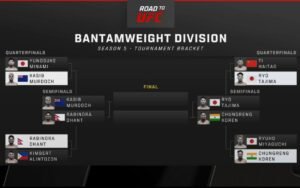
Updated brackets
Bantamweights
Featherweights
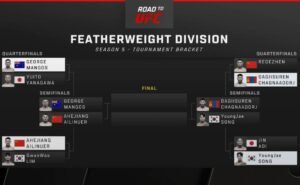
In the Bantamweight bracket, the winner of the Dhant/Murdoch fight should be the favorite to win the whole thing. This fight feels like the finale before the actual finale. For the Featherweights, the remaining fighters could be classified by “Mangos and the rest”. George shown levels above his opposition today, and he should be the winner of the contract at the end of the process.