
Author – James Colwell
September now holds the record for the busiest month in this series’ brief history, with 62 different undefeated fighters competing and earning writeups. These range from top UFC prospects and exciting new talent coming through DWCS to fighters building up their records in obscure corners of the world where only I may be tracking them. Bantamweight was exceptionally active, with 18 members of the rankings adding to their perfect records, while on the other side of the spectrum, no middleweights and just a single heavyweight recorded a win in September.
If you want even more prospect content, check out my parallel Ins and Outs series here, which features 28 new prospects this month and covers the 29 fighters who previously appeared but have since been removed. I expect to see many of those names return in this column for years to come—so get familiar with them and stay on the cutting edge of MMA talent.
My most recent rankings of undefeated fighters are: Heavyweight, Light Heavyweight, Middleweight, Welterweight, Lightweight, Featherweight, Bantamweight, Flyweight. If you’re new, here’s an introduction to the rankings and my grading system. If you somehow don’t have enough to read below, the July and August editions of this column are also available. My comprehensive rankings cover thousands of fighters (undefeated and not) so check those out if you’d like to read more of my direct film notes for anybody.
Top Risers:
- Navajo Stirling: +35, 25/100 to 60/100
- Iwo Baraniewski: +25, 5/100 to 30/100
- Axel Sola: +20, 30/100 to 50/100
- Murtazali Magomedov: +15, 10/100 to 25/100
- Razhabali Shaydullaev: +10, 70/100 to 80/100
- Kurtis Campbell: +10, 10/100 to 20/100
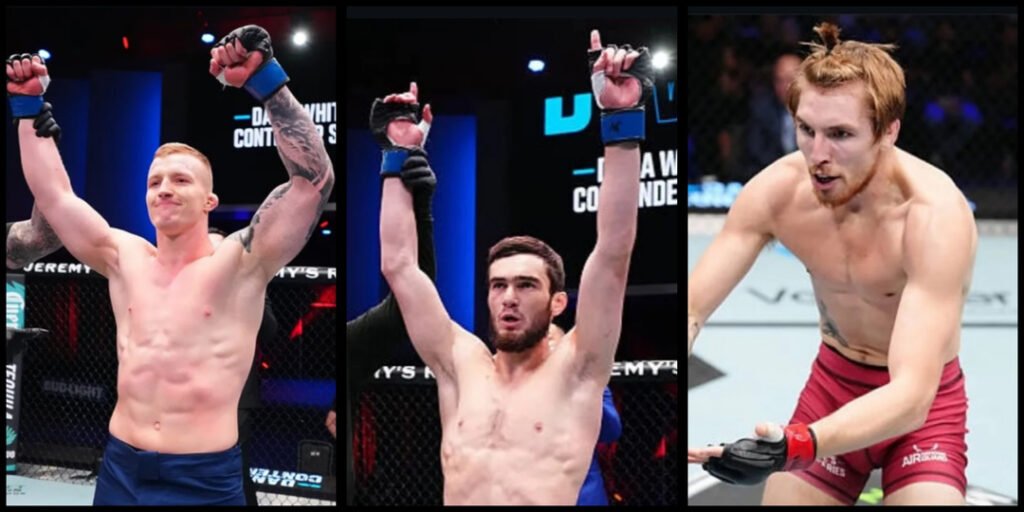
This month’s risers tell a story, as they’re all international-level talents on my grading scale with 5/6 now signed to the UFC after Baraniewski, Magomedov, and Campbell earned contracts with impressive finishes on DWCS. There were lots of other prospects who earned grade bumps with strong performances but the nature of DWCS as a proving ground against other top talent allows these fighters to show just good they really are.
Heavyweights:
Allen Frye: 6-0
Grade: 6.5 (+6)
Frye only joined the rankings in his last fight back in June, scoring a 30-second KO to win a local title, but prospects tend to develop quickly at heavyweight since there’s so little depth. He’s a tall, athletic 6’4” with some college basketball experience and quick feet to match that background. Allen, meanwhile, has been a KO machine in MMA—going 2-0 as an amateur with a knockout and finishing all of his pro opponents—though his first five were inexperienced or just plain bad, with a combined 8-10 record.
On paper, Frye got a huge step up in this most recent fight against Justin Frazier (12-3), who owns a solid record and has fought for both Bellator and the UFC. However, Frazier’s last fight was more than six years ago, and he looked like he’d spent more of that time eating than training, as he missed weight and sported a belly that would have made Roy Nelson proud. Frye stayed safe in the early exchanges, dictated the range with his longer reach, and took over once Frazier gassed in the second minute of the fight. Well-placed shots forced the action to the fence, where Frye poured on the power—including some crushing hooks—for a first-round KO.
Light Heavyweights:
Navajo Stirling: 8-0
Grade: 60 (+35)
I was lower than the consensus on Stirling coming into his fight against Rodolfo Bellato (12-2-1, 45/100), which I actually expected him to lose since I’d been unimpressed by his lack of output and was concerned about his defensive wrestling. The striking played out mostly how I anticipated, with Navajo much quicker and more accurate—landing sharp counters, mixing up attacks to the legs, working the body effectively, and mostly sliding away from power shots in return.
Bellato was able to repeatedly get him into clinches and control him on the fence, which I also expected, but Stirling has clearly been working on his takedown defense. He used a wide stance to stay on his feet for most of the fight, and the only time he was taken down came in Round 3, when a bad habit of exposing his back in clinches resurfaced and gave away a body lock. However, he did a good job of preventing a back take, safely building back up, and even ended up with more top control overall after a solid takedown in Round 2 let him sit in half guard and score with ground-and-pound for several minutes.
His output still wasn’t high, but he picked his moments well. Aside from a somewhat wild exchange late in Round 1, Navajo was smart to avoid the chaotic situations where Bellato is at his most dangerous. He’s had some cardio issues in previous fights, but looked strong here—landing clean kicks and counter hooks deep into the third round as Bellato pushed for a late finish. That was enough to steal the round and secure a 30-27 decision win.
He’s not a KO machine at the UFC level, but I’m impressed by the progression he’s shown in his overall skill set after entering MMA as a kickboxer.
Iwo Baraniewski: 6-0
Grade: 30 (+25)
Baraniewski faced Mahamed Aly (4-0, 9.5/100) on DWCS in a battle between two of my favorite early-career light heavyweights. While their pro records were similar, Iwo had the major advantage of a 17-3 amateur career, which is invaluable experience even if many of those opponents weren’t particularly strong. I was hoping to see some grappling exchanges, as his strong judo background would have been a fascinating contrast to Aly’s excellent BJJ, but instead Baraniewski landed a massive overhand right with his first serious swing of the fight and sealed the 20-second KO with a few accurate follow-up punches while standing over his opponent.
His massive grade boost might seem like an overreaction since there wasn’t time for him to show much, but I’d only had him ranked relatively low before because I was waiting to see whether his lethal finishing skills could translate against a graded opponent. That kind of demolition of someone I expected to beat him rockets Baraniewski all the way up to my #4 undefeated light heavyweight overall—though there’s still quite a gap between him and the top three.
He’s now riding a 16-fight winning streak into his new UFC contract and brings a dangerous combination of grappling, submissions, and raw power that will make him tough to beat. On the downside, he’s a bit undersized for the division, and we’ve never seen him go past the first round as a pro, so his gas tank remains untested—though he did frequently go to 9-minute decisions during his amateur run.
Boris Mbarga Atangana: 7-0
Grade: 10 (+1)
Atangana is one of the best undefeated light heavyweights in Europe and among the top undefeated prospects in the division worldwide. He first caught my attention during a dominant 8-0 amateur run, where his raw physicality and aggression stood out in a string of highlight-reel KOs against overmatched opponents. Since turning pro in May 2024, he’s stayed remarkably active—racking up seven fights in just sixteen months—helped by the fact that six of those wins have come by first-round knockout.
Boris is an all-offense fighter with hugely powerful hands and explosive takedowns, though he still lacks some finesse and can sometimes rush in grappling exchanges or when entering the pocket. His best win came against UFC veteran Raphael Pessoa (10-5, 1/100), where he showed some wildness on the feet and initially struggled with Pessoa’s sheer size and bulk, as the fight took place at heavyweight. However, once Atangana got leverage in the clinch and began chaining transitions from the takedown into mount, he looked excellent—showing strong control and brutal ground-and-pound to earn a TKO.
That win earned him a contract with PFL Europe, where he picked up an easy 56-second victory over a 3-3 opponent in July before returning a couple of months later to face Jhony Gregory (10-4). This was a more reasonable matchup, as Gregory has some grappling ability but most of his losses have come by KO, so it was clear what PFL was hoping Atangana would deliver. He gave everyone the highlight they wanted—landing heavy hooks early, then connecting with a massive left hand that sent Gregory’s mouthpiece flying before finishing with a few big ground strikes.
Hopefully, we see him in a PFL tournament in 2026, as he’s clearly talented enough to put on exciting, high-level fights against serious competition.
Muhammad Said: 8-0
Grade: 9 (+4.5)
Said is a prospect I’ve had my eye on for a couple of years, ever since he scored three consecutive head-kick KOs in Russia, where he spent nearly his entire pro career fighting under his given name, Magomed Saidov, for regional promotion MMA Series. He’s now representing the UAE and has changed his name accordingly, and with his debut for UAE Warriors this month, it seems likely he’s making a push to get signed by the UFC. That would be a very welcome development, as I had assumed that, like many talented Russian prospects, he might remain stuck on the regional scene long-term.
Said has a well-balanced striking game and uses his kicks better than most big men—both to finish fights and to attack his opponents’ legs and body. His hands are solid as well, and he rarely overswings. His defensive wrestling is good enough to keep him safe against most regional opposition, and he’s even pulled off two triangle choke submissions from his back, though those came against weaker competition. His opponent this month, Valmir da Silva (11-4), was clearly the most skilled fighter Said has faced but also stood just 5’8”, making the physical disparity between them impossible to miss.
Said’s cardio isn’t great—he was clearly exhausted past the first round—but he showed the grit needed to push through fatigue and keep scoring points on the feet, earning his first decision win as a professional. I do question whether he’d have been as effective without that massive size advantage, and he might struggle against opponents with elite wrestling and the gas tank to push a relentless pace—but those fighters are rare at light heavyweight.
He earns a big grade boost here, as I was admittedly too low on him coming into this fight based on what he’s shown before. I’d like to see him challenge for the title in his next outing, and a win there should be enough to earn him a DWCS opportunity in 2026.
Frederic Vosgröne: 5-0
Grade: 4.5 (+2.5)
If you’re a fan of Oktagon—or European MMA in general—Vosgröne needs no introduction. He’s an excellent BJJ practitioner who’s been competitive at world-level tournaments, but it’s his caveman-like appearance combined with a unique fighting style based on extremely low single-legs and ground dominance that has made him a sensation. He picked up three regional submissions, including two heel-hooks—a rarity for heavier weight classes—before joining these rankings with a second-round arm-triangle submission over Jorick Montagnac (6-2) earlier this year.
His newest opponent, Fabio Moraes (7-1), had a better record but was much smaller and hadn’t fought in over three years. The fight was essentially over after Vosgröne scored an ankle-snagging takedown in the opening seconds, as it was clear he wasn’t going to let his opponent back to his feet. He spent some time working from guard but displayed his skill with precise, technical passes to half guard and then mount, gradually increasing the volume of ground-and-pound he threw. After an arm-triangle attempt failed, he sank his hips and went wild with hammerfists. While the aggression was impressive, it was clear he’s still new to striking on the ground, as both technique and aim were lacking. He could have done much more damage by picking his shots carefully and landing them through the guard, which we saw briefly when he took the back and landed hooks to the side of his opponent’s head.
It looked like he was on the way to his first TKO win, but instead, he chose to snatch the neck for an easy rear-naked choke submission. The grade increase here comes less from the level of competition and more from Frederic continuing to prove that his style is effective while showing more willingness to integrate ground-and-pound despite his rawness. Oktagon clearly knows they have a potential star on their hands, and it will be interesting to see how long they wait before throwing him into big-name matchups.
Levi Rodrigues: 5-0
Grade: 3.5 (+0.5)
Rodrigues is a good reminder that my grades don’t always translate perfectly between weight classes. He’s a thunderous hitter with accurate hands and passable grappling, though he does have some conditioning and fight IQ issues. That might hold him back at lower weights, but at light heavyweight and heavyweight, he’s one of the better undefeated early-career prospects around.
He’s been on my radar since his pro debut, a 32-second KO following a 5-0 amateur career where all of his wins came by first-minute KO. He looked like a rising star after two more KO wins for LFA but then disappeared for nearly two years. His return at heavyweight was underwhelming; he allowed a 3-3 opponent to land too many clean shots and only won in the third round when that opponent injured his shoulder while throwing a punch.
A return to LFA and his natural weight class seemed to suit Rodrigues this month, as he scored another first-round KO with a single left hook against Alan Ribeiro (3-1). While he looked strong, Rodrigues only earns a 0.5 grade increase, as this was a level of competition he’s already proven he can beat. He’s now on a 10-KO streak, and though I don’t think he’s ready for the UFC yet, light heavyweights with worse records and skill sets have consistently earned DWCS opportunities in recent years. I wouldn’t be surprised to see Rodrigues there in 2026, especially if he picks up another win before then.
Emilio Quissua: 7-0
Grade: 2.5
Quissua is a solid fighter with skills in multiple areas and good athleticism, but he doesn’t particularly stand out in any one aspect. He has power in his hands, but his technique and decision-making are limited, so he often resorts to wild overhands. He’s strong but not shredded and can struggle with cardio. He can wrestle well enough to control positions, but he’s not going to dominate true grapplers, and his BJJ is mostly defensive, though competent.
I was high on him when he beat Kevin Oumar (8-3) for the UAE Warriors belt in just his fourth pro fight, but that was three years ago, and he hasn’t progressed as much as I would have liked in that time. He did pick up a decision win over his first graded opponent in January—Juscelino Ferreira (12-4, 0.5/100)—and while it was a well-rounded performance over a decent gatekeeper, it also highlighted his lack of standout traits.
Quissua got an easy matchup for his Oktagon debut against short-notice replacement Mateusz Strzelczyk (15-14-1), who offered little resistance, allowing Emilio to secure a first-round KO with ground-and-pound. He’s good enough to dominate that level of competition, but this fight doesn’t earn him any grade boost. I think he’ll have a very successful career with Oktagon, but that may ultimately be his ceiling.
Samuel Chavarría: 6-0
Grade: 1.5
Chavarría is a natural welterweight—and a promising one at that—with height (6’1”), athleticism, and youth (24 years old) on his side. He’s the only Honduran prospect in my undefeated rankings and has spent his entire career with local promotion Ultimate Combat Challenge, including a 3-0 amateur record. All of his wins have come by KO or decision, and the limited footage I’ve seen shows a striker who is so physically superior to his opposition that he doesn’t have to rely heavily on flawless technique—though that will obviously become a factor if he moves to a tougher promotion.
He’s faced some inexperienced fighters but also a few decent regional opponents, which is about as much as you can hope for given his circumstances. Chavarría had been inactive for a year, and the difficulty of finding opponents in a small country likely motivated him to jump two weight classes—35 pounds—for his most recent fight. His opponent was 5’8” and making his professional debut, so while I can’t find a picture, I have to assume he was carrying extra weight to make the 205-pound limit.
Samuel did what was necessary and scored a first-round KO, but I’m not going to reward matchups like that with a grade boost. It’s a little odd to see him ranked at light heavyweight, but I assume he’ll be back at 170 pounds for his next fight.
Middleweights:
Despite the absolutely crazy slate of events this month, not a single undefeated fighter in my rankings fought and won in September.
Welterweights:
Axel Sola: 11-0-1
Grade: 50 (+20)
Sola moved up from lightweight for his UFC debut against Rhys McKee (16-6-1, 20/100) and showed why he was our Creative Minds #9 overall prospect before earning the contract. His resume is both extensive and high-quality, with a 19-5 amateur record against top competition in IMMAF, early wins over strong prospects in Brave, and a dominant title reign in top French promotion Ares, consistently defeating graded opponents. His lone draw came in his toughest fight against Daguir Imavov (15-3-1, 15/100), where he got hurt early in an 8-10 first round and had to rely on grit and wrestling to take rounds, finishing with a 47-47. He went on to defend his title three more times, making it clear he was ready for the UFC.
Despite a noticeable size disadvantage, Sola’s hands looked sharp against McKee, particularly his straight left, which he effectively targeted to both the head and body. He’s a strong wrestler who prefers body locks at the fence to set up knees to the lower body and wear down opponents early—a strategy he successfully implemented in this fight. Round 2 saw him briefly slowed after an eye injury, and he got hit cleaner than usual, likely due to rarely facing someone with such a long reach. Still, he did a good job buying time until he could go back on the offensive and consistently landed cleaner strikes during exchanges.
Sola secured the sixth KO of his career in Round 3 with a perfectly placed liver shot combined with hammerfists, though the referee stopped the fight a few seconds early. It’s rare for someone with that many KOs to have none in the first round, but that’s the case with Sola—speaking to his attritional style that blends boxing and wrestling to establish dominant positions before finishing, rather than relying on one-shot fight-enders. I expect him to return to 155 pounds in the UFC, and I think he has the tools to challenge for a top-15 ranking by this time in 2026.
Alvi Dasuyev: 7-0
Grade: 7 (+2)
I wasn’t fully sold on Dasuyev after his amateur career, despite an impressive 13-3 record and some solid wins, because he lost decisions to the two best prospects he faced. However, he’s leveled up significantly as a pro, putting together five KOs and two submissions in just 16 months while steadily facing tougher competition. He’s tall, uses his range well, and has a creative, damaging kicking game; when opponents get past that first layer, his slick boxing greets them. He rarely wrestles offensively, but his scrambling and takedown defense are both well-trained.
Most of his fights have come in his native Belgium, with his only win over a graded opponent in June against Tyrone Pfeifer (5-0, 1.5/100), which Dasuyev secured in the first round with a one-shot straight left to claim a local title. He then followed up with a flying knee KO against a journeyman just weeks later before making his LFA debut this month against Daniil Prikaza (16-7-2), a quality striker who was on a slump. Dasuyev was clearly the quicker fighter, circling the cage effectively while consistently finding space to land kicks to all levels. His calf kicks slowed his opponent, and his body shots made his switches to the head hard to predict. His jab was especially accurate, making it difficult for Prikaza to establish any consistent offense.
Dasuyev took a few bigger overhands late in Round 2 and early in Round 3, which may indicate some fatigue and sloppy defense, but he never looked hurt and maintained solid output with his own striking. He didn’t seem eager to press for a finish, instead accumulating damage until suddenly exploding with a knee into a flying switch kick that dropped his opponent. He then followed up with hammerfists to seal the deal, though the KO was already secure.
At 23 years old, with a 100% finishing rate—including a highlight-worthy performance in LFA—it’s easy to envision him on DWCS in 2026 or as a potential PFL Europe signing.
Anthony Orozco: 8-0
Grade: 3 (+0.5)
Orozco featured in the first edition of this column with a one-sided decision win over a Brazilian journeyman, and a couple of months later he returned with essentially the same performance. He faced Aldo Pereira (12-8-2), a decent striker who had no answer for Orozco’s wrestling and never really threatened him on the feet either.
A decision win feels somewhat underwhelming here, as Orozco had so much control time that I would have liked to see him take more risks and look for a finish. Anthony has an impressive record, especially for a prospect whose entire career has come in Cage Warriors, but he’s unlikely to make significant progress toward a title shot or a DWCS call unless he starts putting more highlight-worthy moments on tape.
Rizwan Ali: 10-0
Grade: 2 (+1)
Ali is the only undefeated prospect currently representing Pakistan, and he’s one of the top prospects overall from a country with a notoriously weak and often inconsistent MMA scene. He checks the basic boxes you want from a prospect: athleticism, height, finishing instincts, and a well-rounded skill set.
Most of his competition at home was underwhelming, with seven opponents combining for a 3-7-1 record. While he’s 2-0 for Brave CF, both wins came against Srikant Sekhar (7-7 and 7-8) in matchups designed around the Pakistan-India rivalry rather than testing Ali’s skill as a fighter. I still have reservations about his overall ability and ceiling, but he showed his cardio is solid with a second decision win—his first victory over a quality opponent—in Adham Mohamed (11-4).
Ali is a natural lightweight but moved up to 165 pounds for this fight, which actually took place in late August, though the result wasn’t announced until September. Hopefully, his next fight will be back with Brave, where he can face tougher competition; he’s at prime fighting age and needs to elevate his career now if he’s ever going to reach his potential.
Oualy Tandia: 4-0
Grade: 1.5 (+0.5)
Sometimes the hype around a prospect can outpace their actual ability, and I think that may be the case with Tandia. Don’t get me wrong—he’s a talented prospect with an unteachable blend of 6’3” height, flexibility, power, and fast hands for the division—but MMA in France is red-hot, and some fans there have prematurely painted him as a superstar. His 25-3 amateur career was as decorated as it was extensive, and I was very high on him during the 20-win streak he put together. However, almost all of those wins were in France, and his comparatively weak wrestling was exposed in IMMAF against Kosim Sardorov (14-4 amateur at the time, now 5-0 pro and a very exciting prospect).
Oualy beat one bad opponent to regain a little momentum before turning pro and has fought four times in 2025 for the fast-growing Hexagone MMA. His first three opponents combined for a 4-2 record, which is fine for someone starting their career but not particularly challenging given his amateur experience. He went to a decision twice, but what was more concerning was that many viewers—including myself—felt he lost against Rivaldo Pereira (1-1) and was saved by some hometown judging. Grappling remains his weak point, and his cardio has occasionally faltered in the third round.
His September fight came against Alix Jean-Guillaume (8-9), who has been finished in the first round of all of his losses and clearly shouldn’t have been a serious challenge. Tandia was much faster and threw some nice combinations, but left his chin exposed early, getting caught by a straight—though he responded well with an up-knee. This forced his opponent to grapple, and while Tandia did well to prevent a takedown, it was still concerning to see him stuck on the fence for several minutes against this level of competition. He didn’t even escape cleanly, requiring the referee to separate the stalled position, though he did land a highlight with a clean left knee to the chin as his opponent attempted another level change.
I expect Hexagone to keep building him slowly, which is a smart approach since he clearly needs more time to improve his wrestling.
Lightweights:
Akbar Abdullaev: 13-0
Grade: 70 (+5)
Abdullaev is my highest-rated fighter on the ONE Championship roster, regardless of weight class, and I think he could give some UFC top-15 fighters serious problems. He’s explosive, aggressive, and capable of dominating fights with both striking and wrestling, having finished everyone he’s faced—with 12 of those wins coming by KO.
He would have already claimed the title after battering Kai Tang (19-3, 45/100) for more than 20 minutes and finishing him in Round 5, but he missed weight and was disqualified from winning the belt. Instead of a rematch, he faced Ibragim Dauev (11-1, 10/100), a strong wrestler on an impressive win streak, but Abdullaev dismantled him in this fight. He picked his opponent apart with jabs on the feet, which set up his other strikes, and while he spent some time being pushed to the ropes in Rounds 1 and 2, he was never in real danger. He consistently reversed takedowns into top guard control each round, applying relentless pressure. Each hook or overhand elbow carried real power, and though he rarely postured up, he was able to generate significant leverage with solid technique to deal consistent damage.
Dauev’s guard is very active, but after a triangle threat in Round 1, Abdullaev adapted and effectively shut down similar attacks, though he struggled to control his opponent’s legs for more than a few seconds at a time. The beatdown continued until a referee stand-up in Round 3 allowed Abdullaev to land a clean straight-right knockdown, finishing the fight with a big flurry. Unfortunately, he missed weight again for this fight due to struggles with ONE’s hydration rules, leaving his next path unclear.
Darragh Kelly: 9-0
Grade: 30 (+5)
Kelly has long been considered one of Ireland’s top prospects, boasting a dominant submission arsenal and improved striking that has propelled him to 18 consecutive wins without a defeat. He faced strong competition as an amateur, finishing all nine of his opponents, before easing into his pro career with Bellator. There, he faced a couple of prospects—Mathias Poiron (7-1, 0.5/100) and Dmytrii Hrytsenko (9-0, 9.5/100)—before Bellator merged with PFL. Kelly made a strong debut in PFL by outgrappling Mike Hamel (11-6, 10/100), proving he belongs at the international level of MMA.
His opponent this month, Bakhtiyar Abdulaev (10-1, 0.5/100), was a step down: a natural featherweight who hadn’t fought in three years and was unproven against anyone of Kelly’s caliber. The fight was a one-sided mauling. Kelly landed a heavy straight right, secured a clinch, and used his clear strength advantage to get a takedown. He followed with solid ground-and-pound, executed a beautiful sweep when briefly reversed, and took the back with hooks to the head, finishing with a quick rear-naked choke.
While the matchup was clearly mismatched, Kelly earns a grade bump for how dominant he looked. I’m interested to see how he performs in PFL’s main tournament in 2026.
Marcelo Marques: 12-0
Grade: 20 (+5)
Marques has been hovering just outside my top-25 regional prospects for a while, largely due to a split decision win over Luann Sardinha (8-0, 15/100) that demonstrated he’s a high-level fighter, though the fight could have gone either way and many observers thought he lost. He’s an unusual prospect as a 5’7” lightweight who likes to tie his opponents up, make things grimy at the fence, or take them down and hunt for rear-naked chokes and arm-based submissions. It’s a style I’m more accustomed to seeing from Russia or nearby regions, but Marques has the athleticism and skill set to make it very effective. His accolades include a high-level BJJ black belt, a Muay Thai black belt, and strong judo. His win over Sardinha saw him control long stretches of the fight and score with volume strikes, including short knees in the clinch, though he struggled with the reach and precision of his taller opponent.
Marques picked up a much clearer decision win this month against Felipe Oliveira (11-4, 2/100), an underrated fighter with skills across the board who was outclassed in this matchup. Marques controlled the pace and distance from the opening minutes, getting inside to land shots while maintaining tight guard and precise footwork to limit openings for counters. He dominated with takedowns, top control, and back takes in Rounds 1 and 2; while he never came particularly close to a submission, his transitions were slick and he effectively mixed in strikes while maintaining control. Round 2 also highlighted his cage grappling, where his short, powerful build gives him leverage and an edge in controlling opponents. He was eventually reversed, and while there were no major clinch moments, it was clear he could have dominated most of those exchanges if necessary.
Round 3 was mostly conservative as Marques managed his lead, landing enough shots to stay ahead while his opponent failed to force any risky exchanges. He displayed flair throughout the fight, including spinning attacks like a wheel kick that wobbled Oliveira late and set up nasty punch flurries. While his height will always present challenges against long, elusive strikers, Marques has the grappling, strength, cardio, and striking to be a quality UFC fighter if given the opportunity.
Nikita Kulshin: 8-0
Grade: 15 (+6.5)
If MMA careers were strictly based on talent, Kulshin would probably be in the UFC for his next fight. He’s well-rounded, athletic, and just entering his prime at 25. Unfortunately for him, styles and the entertainment value they bring often determine the opportunities fighters receive, and his track record so far isn’t likely to compel the big show to call.
His resume is impeccable: 6-0 as an amateur—including two standout opponents on his way to the 2019 IMMAF world title—and perfect as a pro, including three debuting fighters in Russia and a 5-0 run for LFA against quality opponents with a combined 46-20 record. However, all his amateur wins came by decision, and six of his pro wins have also gone the distance, including his last four straight. His only finish in the U.S.—a 17-second demolition of Geovani Cruz (6-4)—was exciting but hasn’t carried over against better competition.
His most recent opponent, Bobby Lee (15-9, 3/100), has an ugly record due to consistently fighting strong competition in LFA and an 0-3 run in Bellator, but he represented the toughest challenge Kulshin has faced so far. The first round perfectly showcased Kulshin’s promise and fight IQ, but also why he frequently goes to the judges. His hands are fast, highlighted by an extended combo of hooks thrown powerfully and accurately at close range for a knockdown. That precision was followed by top control from guard for the rest of the round, fending off submission attempts—including a nasty kimura—and scoring points to the body and head.
Kulshin continued to look sharp on his feet in Rounds 2 and 3, easily shutting down takedown attempts but smartly transitioning to body locks or back into guard when offered. This approach maximized his chance of winning, as his top pressure is excellent, using shoulders and hips to limit movement and neutralize submission threats. However, he lacked urgency to pass into better positions or posture up for fight-changing ground-and-pound. He also had a major lapse in R2, narrowly avoiding a point deduction for throwing a knee to the head while his opponent was clearly grounded.
He was so clearly superior in both striking and wrestling that his opponent resorted to risky submission attempts, including a late-round guillotine that forced a technical scramble but ultimately left Kulshin back on top, scoring more points to secure a clean 30-27 decision win. Beating a high-quality opponent so comprehensively earns him a significant boost in my evaluation, but he’ll likely need a highlight-reel finish or several more strong wins to force a UFC/DWCS offer. I grade him very similarly to current LFA champ Richie Miranda, an excellent wrestler, and would love to see them face off for the belt.
Tommy Gantt: 11-0
Grade: 10 (+6.5)
If MMA careers were strictly based on talent, Kulshin would probably be in the UFC for his next fight. He’s well-rounded, athletic, and just entering his prime at 25. Unfortunately for him, styles and the entertainment value they bring often determine the opportunities fighters receive, and his track record so far isn’t likely to compel the big show to call.
His resume is impeccable: 6-0 as an amateur—including two standout opponents on his way to the 2019 IMMAF world title—and perfect as a pro, including three debuting fighters in Russia and a 5-0 run for LFA against quality opponents with a combined 46-20 record. However, all his amateur wins came by decision, and six of his pro wins have also gone the distance, including his last four straight. His only finish in the U.S.—a 17-second demolition of Geovani Cruz (6-4)—was exciting but hasn’t carried over against better competition.
His most recent opponent, Bobby Lee (15-9, 3/100), has an ugly record due to consistently fighting strong competition in LFA and an 0-3 run in Bellator, but he represented the toughest challenge Kulshin has faced so far. The first round perfectly showcased Kulshin’s promise and fight IQ, but also why he frequently goes to the judges. His hands are fast, highlighted by an extended combo of hooks thrown powerfully and accurately at close range for a knockdown. That precision was followed by top control from guard for the rest of the round, fending off submission attempts—including a nasty kimura—and scoring points to the body and head.
Kulshin continued to look sharp on his feet in Rounds 2 and 3, easily shutting down takedown attempts but smartly transitioning to body locks or back into guard when offered. This approach maximized his chance of winning, as his top pressure is excellent, using shoulders and hips to limit movement and neutralize submission threats. However, he lacked urgency to pass into better positions or posture up for fight-changing ground-and-pound. He also had a major lapse in R2, narrowly avoiding a point deduction for throwing a knee to the head while his opponent was clearly grounded.
He was so clearly superior in both striking and wrestling that his opponent resorted to risky submission attempts, including a late-round guillotine that forced a technical scramble but ultimately left Kulshin back on top, scoring more points to secure a clean 30-27 decision win. Beating a high-quality opponent so comprehensively earns him a significant boost in my evaluation, but he’ll likely need a highlight-reel finish or several more strong wins to force a UFC/DWCS offer. I grade him very similarly to current LFA champ Richie Miranda, an excellent wrestler, and would love to see them face off for the belt.
George Staines: 7-0
Grade: 10 (+2.5)
Staines was one of the best amateurs I’ve seen in a while, racking up 16 straight wins against excellent competition, including several belts in the UK and the 2022 IMMAF European title. However, that same opponent from the finale derailed his momentum by handing him a decision loss in his final amateur fight.
He has rebounded well as a pro, winning six fights for Oktagon—initially against inexperienced opponents, then gradually stepping up in competition before making the switch to Cage Warriors. George has a ton of tools at his disposal: his 6’1” frame gives him a reach advantage for striking at distance, but he can also impose his will through grappling, using strong top control and submission threats.
His last two fights have highlighted his stylistic flexibility. His final Oktagon matchup against Hafeni Nafuka (10-2, 1.5/100) was his only win over a graded opponent. In that fight, Staines faced intense pressure from a very strong wrestler but displayed excellent movement, a diverse striking arsenal, and the ability to escape or recover when stuck on the fence. He did chase guillotines too often—a recurring bad habit—and made some errors in cage wrestling and grappling decision-making, but his skill and athleticism were enough to cover those gaps and regain control. When given the opportunity to do damage, he clearly capitalized, earning a clean 30-27 decision win.
His most recent opponent, Willian Batista (12-6), was a step back in competition but still a quality fighter in good form. Staines began the fight using a similar approach to his matchup against Nafuka, trying to score from the outside with long straight punches and mixing in kicks. This style, however, gave his shorter opponent opportunities to close the distance and get wild.
The first takedown came a couple of minutes into Round 1, timed well with a knee to bring the fight to the ground without much effort. In Rounds 2 and 3, Staines shot earlier to prevent his opponent from landing anything significant. Once on top, the fight became one-sided, with Staines maintaining seemingly effortless control and consistent ground-and-pound volume. His elbows were the most effective weapon on the ground, though he didn’t utilize them enough to maximize damage given the number of strikes thrown.
He chased a guillotine late in Round 1, but the risk was minimal and didn’t cost him much. I would have liked to see more posturing to add power to his punches and more aggressive attempts to pass guard, though he could regain control when necessary. Ultimately, Staines fought smart, earning a clear 30-27 decision while taking little damage. Cage Warriors has sent many prospects to DWCS and the UFC, and with one more fight for them, I expect Staines to join that list in 2026.
Jefferson Nascimento: 12-0
Grade: 10
Nascimento is a well-rounded prospect with a background in BJJ, though he’s grown increasingly fond of striking and can now mix it up effectively in all areas. He’s faced strong competition, especially in LFA, with five opponents combining for a 44-10 record. He won their interim title in 2023 over Gabriel Costa (8-0, 2.5/100) before disappearing for almost two years. He also has notable wins over Italo Gomes (12-3, 2/100) and Matheus Rocha (5-0, now graded as a prospect), and these victories have elevated him to an international-level grade. However, he has yet to prove elite in any single aspect of MMA, so true specialists can still give him problems.
That was evident in his most recent fight against Baysangur Makaev (7-1, 1/100), who used grinding wrestling to control most of the fight and get on top every round, though he couldn’t make much progress in Nascimento’s technical guard. Nascimento’s takedown defense left something to be desired, but he displayed solid preventative work off his back and avoided serious damage despite taking a high volume of ground-and-pound strikes. He was also fortunate that the referee stood them up several times, as he may not have escaped on his own.
On the feet, Nascimento clearly had the advantage, landing thudding shots to the head and body when space was available and stunning his opponent multiple times. He also showed a deeper gas tank, staying on his feet longer against an exhausted Makaev in the later rounds. Scoring the fight came down to control versus damage, and ultimately Nascimento’s impact earned him a narrow 48-47 decision win. His grade doesn’t increase due to concerns about his wrestling defense, but he is now 5-0 for LFA and 5-0 for Shooto Brazil, which should put him in line for a DWCS opportunity in 2026 if he remains active.
Tyler Grimsley: 11-0
Grade: 9 (+3)
Grimsley has long fit the profile of a top American prospect, boasting a wrestling background, solid athleticism, a 5-0 amateur record, and an undefeated pro career. He has finished 10 of his 11 professional fights, but questions have lingered about the level of competition he faced in smaller promotions across the U.S. and Canada. Only four of his professional opponents held winning records, and none were graded in my database until his most recent fight against Chad Decker (7-0, 1.5/100).
While I couldn’t find footage of the fight, Grimsley won by TKO in Round 4 to defend his title for Motor City Cagefights. This result shows he can handle another rising prospect and has the cardio to succeed in later rounds. It’s relatively rare for an American with such an extensive undefeated record not to be on the UFC’s radar or at least competing for a promotion on Fight Pass. I’d expect to see him in a Midwestern promotion like Anthony Pettis FC or LFA for his next fight.
Salah Eddine Hamli: 10-0
Grade: 8 (+0.5)
Hamli is currently the only undefeated prospect representing Morocco, and he’s making the most of it as a well-rounded fighter, particularly effective in grappling. He lost his amateur debut but has since put together a 14-fight winning streak, including dominant performances on the regional scene in Spain. His standout win came by decision over Gabriel Pasqualotti (6-0, 1.5/100), a dangerous KO artist whom Hamli neutralized with his wrestling and BJJ.
That performance earned him a spot in PFL MENA, where he’s now secured two third-round submissions using a patient—though sometimes overly cautious—style to control and wear opponents down before finishing them late in the fight. His September opponent, Souhil Tairi (8-6-1), wasn’t on his level, so it would have been nice to see more aggression, but the results speak for themselves, and he’s still consistently finding finishes even if they’re not explosive. Hamli is set to face Mohammad Fahmi (written up below) in a clash of undefeated fighters that I expect him to win. This bout will determine the tournament winner and likely propel the victor to a bigger opportunity within PFL.
Sayat Abduali: 9-0
Grade: 5.5 (+3.5)
Abduali is a tall (6’1”) rangy fighter who has spent his entire career in Kazakhstan with Oktagon, gradually building his record against weaker competition—his first eight opponents combined for 29-24-2—before earning a title shot this month. On the feet, he fights with good volume, solid boxing technique, and effectively uses his length, though I’d like to see him incorporate more kicks into his game. His power isn’t spectacular, but his precision allows him to occasionally land a clean shot capable of causing serious damage.
Sayat is at his most dangerous on the ground, threatening from all positions with a mix of triangles and armbars off his back, or strong progressive wrestling from top position that transitions into back takes and RNCs. He even pulled off a flying triangle choke last year, using unconventional leg positioning and his relatively skinny calves as a vise to force a tap.
Abduali faced a solid challenge for the title in Amirkhon Alikhuzhaev (12-5), an aggressive finisher with skills everywhere, though not elite. It was impressive to see Abduali’s striking finesse and grappling translate to this level, as he met the challenge and secured another RNC submission late in Round 1. At just 22 years old, he has noticeably improved over the past few years, suggesting a high ceiling and making it exciting to see where his career goes next.
Ethan Burmingham: 6-0
Grade: 4.5 (+2)
Burmingham possesses most of the tools needed to become a top-level prospect, but he still needs time to fully put things together. Fortunately, at 21 years old, time is on his side. He stands 6’0” with long limbs but remains somewhat skinny, having started at 135 pounds as a teenage amateur and only moving up to lightweight about a year ago. That lack of muscle occasionally allows bigger opponents to toss him around, but his background in BJJ and excellent scrambling technique have helped him overcome every challenge so far, giving him a 14-fight win streak (8-0 as an amateur, including a couple of titles).
His first five pro opponents included several low-level fighters but also a few decent regional names, which is fair competition for a young prospect. He had one fight for LFA but otherwise has only competed on small regional cards. It was, therefore, quite a surprise to see Ethan booked for WOW in Spain against Sebas Santana Guedes (13-7-1), a savvy grappler and by far the toughest opponent of his career.
There were several promising signs in this fight. Burmingham is learning to use his length on the feet, landing clean calf kicks and teeps to open rounds, along with a few jabs, though none carried significant power. His throws from body-locks were excellent, including a highlight in the first round, and he repeatedly worked to a unique position at the base of the fence where he trapped his opponent’s ankles while both were seated. Though not as dominant as a traditional leg shelf (think Khabib), this allowed him to land punches to the body and some sneaky elbows while keeping his head slightly elevated to prevent Guedes from popping up.
There were also some concerns. Ethan was immediately swept the first time he was taken down in Round 1 and spent too long on his back chasing guillotines in Rounds 2 and 3, giving his opponent time to work GnP. His flexibility is excellent, and Round 3 featured chaotic but beautiful rolls and scrambles where he often came out on top, yet he lacked the hip drive to settle into dominant positions and got outmuscled in some exchanges. He also exposed his back frequently, allowing Guedes to close his grip, though Burmingham was able to escape by rolling.
The end of the fight saw his most sustained back control with some punches to distract and attempt an RNC, which never came. He secured a 29-28 decision win and clearly has tremendous potential if he continues to develop his long-range striking, adds more power, and uses his strength to better control wrestling exchanges so he isn’t forced to scramble so often.
Dmitriy Kireev: 7-0
Grade: 4 (+2.5)
Kireev is a kickboxer who has built his career entirely in RCC, facing experienced and consistently solid opponents (62-36-1 combined record), though none of them are graded in my database yet. Most of his wins have come by decision, reflecting his style of using movement and kicks to outscore opponents at range. Offensive wrestling isn’t a major part of his game, but competing in Russia has required him to develop solid defensive grappling to avoid getting stuck in bad positions.
Dmitriy’s profile received a major boost this month with a highlight-reel 30-second head-kick KO of Denis Sulimov (7-3). His opponent was also a striker, which made for a favorable matchup, but few could have predicted the fight would end so explosively. This performance earns Kireev a notable grade increase, and at 26 years old—entering his prime—his future looks promising. For a deeper dive into his style and potential, one of my Creative Minds colleagues has an in-depth breakdown of Kireev, so check that out for much more info on his style and potential.
Mohammad Fahmi: 6-0
Grade: 4 (+3)
2025 has been a breakout year for Fahmi. He had previously flown under the radar after three wins against weak opponents in Iraq and a single ONE Championship appearance last year, where he picked up a decision over a 3-1 fighter. At 5’7”, he’s short for the division, but his compact, muscular build—combined with experience mostly at 170 pounds—helps offset the height disadvantage.
He entered the PFL MENA tournament as a wild card and immediately showcased his grappling, submitting Georges Eid (10-5) with a first-round D’Arce choke. His next test, last year’s champion Mohsen Mohammadseifi (8-2, 2/100), was much tougher on paper. Fahmi executed a textbook single-leg takedown on the fence, dominated from top position, and methodically worked through guard with precise GnP. From side control, he progressed to mount, forced his opponent to give up the back, and ultimately secured the third RNC of his career.
While he’s benefited from favorable matchups against mostly one-dimensional strikers, his ground game is undeniably impressive. That said, his upcoming clash with Salah Eddine Hamli in December will likely be his toughest test yet, and Hamli may prove too much for him.
Abe Alsaghir: 8-0
Grade: 2.5 (+0.5)
Alsaghir returned just two months after his first appearance in this series to challenge for the inaugural title of a relatively new promotion. His opponent, Juan Porto (11-5), had the strongest record of anyone Abe had faced so far, but at 40 years old and with most wins against early-career fighters in Uruguay, he was far from a serious test. Abe quickly overpowered him and scored an easy first-round KO, earning a slight grade boost. He’s on track for a DWCS appearance in 2026, though he still hasn’t faced enough high-level competition to gauge how he’d fare there.
Théo Ulrich: 6-0
Grade: 1.5
Ulrich is a tall, heavy-hitting French prospect with a strong amateur background (12-1, though only in France) and a perfect professional record for Hexagone. His competition has mostly been mediocre (14-8 combined record), but he’s shown athleticism, deadly striking, and enough grappling to stay safe and control where the fight goes.
His most recent bout raised some concerns. Early on, he took a body kick from Mohamad Baillot (3-2) and dropped his guard, allowing a partial head kick to stun him. He was wobbly but managed to tie up and slow the action on the fence to recover. Baillot then attempted sloppy takedowns, which Ulrich correctly defended, preferring to strike and chip away on the feet. As Baillot’s gas tank emptied, Ulrich landed cleaner combinations, scored a knockdown, and finished with continuous GnP.
While the win gives him five KOs and an R1 finish on his record, the early vulnerability raises questions about his long-term durability. He also benefited from his opponent’s poor decision-making and rapid gas depletion, so his grade doesn’t improve, and he drops a few spots in the rankings despite the victory.
Featherweights:
Razhabali Shaydullaev: 16-0
Grade: 80 (+10)
Shaydullaev is an elite featherweight prospect who would slot into the UFC top-10 immediately if he left Rizin. I first noticed him in a small regional tournament in Kyrgyzstan, and over four years he’s become a nearly unstoppable force. His latest outing against Viktor Kolesnik (26-4-1, 15/100) showcased this perfectly: he walked through a dangerous striker with nine straight wins, landing jabs and overhand rights that scored a knockdown, then finished the fight in just 33 seconds with powerful top control and crashing left hooks.
He now sits at 5 KOs and 11 submissions, all victories coming before the second round. Notably, Tapology recently added two early-career wins to his record, moving him from 13-0 to 16-0, further cementing his status as one of the top undefeated featherweights in the world.
Murtazali Magomedov: 10-0
Grade: 25 (+15)
Magomedov’s DWCS Week 7 bout against Brahyan Zurcher (9-0, 7/100) was highly anticipated, as it matched my two highest-rated fighters of the week. Instead of a drawn-out battle, it turned into a decisive display: Murtazali’s speed and precision dominated from the first jab, landing a flush uppercut and left hook while shifting stances, then finishing with ground-and-pound in under 100 seconds.
This performance brought him to five KOs and five submission wins, and marked his best showing against the toughest opponent he’s faced yet. Previously an international-level prospect without a graded opponent, this fight earns him a boost in my rating. At 26, he’s entering his prime; while his lack of elite athleticism might cap his ceiling as a top contender, he’s set up for exciting fights and plenty of highlight-reel victories in the UFC.
Kurtis Campbell: 8-0
Grade: 20 (+10)
Campbell enters the UFC off this year’s Contender Series as one of the highest-ceiling prospects in the sport, thanks to his blend of technical striking, dangerous grappling, and intelligent fight IQ. I’ve tracked him since his amateur days, and after a lone setback at 16, he’s gone 15-0, collecting numerous UK amateur titles before becoming FCC’s top pro star. Most of his finishes came quickly, though he went the distance against the two graded opponents I had tracked—Sean Pero (5-0, 1.5/100) and Matheus Lima (5-0, 1/100). The 25-minute fight with Lima demonstrated his cardio, showing he could maintain his kicking and wrestling blend at a high pace for the full duration.
As a pro, he defended his FCC title twice against solid regional competition, earning an international-level grade prior to this month’s fight. His opponent, Demba Seck (10-2), was the most physically gifted man he’s faced and came in with a highlight reel full of finishes. Campbell quickly neutralized that athleticism: after landing a few kicks early, he caught Seck’s return to execute a takedown, rode out several explosive escape attempts, then landed knees to the face on a bent-over opponent and followed up with precise GnP to secure an 80-second TKO.
This performance earned him a major grade increase despite the opponent not being ranked. At 23, Campbell’s potential likely surpasses Magomedov’s, though he currently ranks slightly lower due to the difference in opposition. One solid UFC-level win could immediately vault him into the elite tier of prospects.
Tommy McMillen: 9-0
Grade: 10 (+7)
McMillen is a physically imposing 145er who had previously fought at 160 pounds before cutting down for his DWCS matchup against David Mgoyan (7-0, 7/100). Tape on him was limited, and while he’d finished all his earlier opponents in R1, most of those fights were in Montana against lower-level competition. Given his size, I expected him to rely on power and pressure for an early finish, while Mgoyan’s technique and all-around skills made him my pick to control the fight.
Instead, the fight played out differently: McMillen found some success early in R1 but absorbed damage from hooks and head clashes due to a habit of leading with his head down the centerline. He took more punishment on the fence and on the ground, including being caught in a mounted guillotine that would have finished most fighters—but he escaped, showing impressive toughness. His cardio was also better than anticipated, allowing him to maintain a high pace while sprawling hard on takedowns, threatening his own submissions from headlocks, and landing the heavier strikes on the feet, even if not perfectly timed.
The big grade increase comes from defeating a higher-ranked opponent while demonstrating heart, wrestling skill, and durability that hadn’t been evident in his earlier bouts. He nearly secured a late KO with sustained pressure and strikes in the final minute. The fight ended as a 29-28 majority decision, though I personally would have scored R1 differently; even a draw wouldn’t have stopped McMillen’s stock from rising. He’ll need to improve his striking defense and kick timing to reach his full UFC potential, but he’s set up for entertaining fights and a promising career.
Otabek Rajabov: 4-0
Grade: 9.5 (+3)
Rajabov has only been in the rankings for two months, but he’s already back in Pancrase, and fighting above his natural weight should make staying active easier. He faced the experienced but inconsistent Raiki Endo (17-15-5) and clearly outclassed him, combining aggressive, high-output striking with technical precision. He hurt Endo with his boxing before finishing with knees near the fence for a TKO. Every fight continues to build the case that Rajabov could become a star, though he still hasn’t faced any other graded opponents.
Kazuki Aimoto: 8-0
Grade: 3.5 (+1)
Aimoto is a dynamic striker who’s spent his entire career with DEEP in Japan. He started fast, racking up seven wins in about 1.5 years, including a R1 KO of Kei Maezono (7-1, 1/100) that first put him on the prospect radar. His 2025 outing against Takeaki Kinoshita (9-9-1) was a clear mismatch, but Aimoto made it look effortless—he dropped Kinoshita with an opening flurry of hooks and finished with hammerfists for a 14-second KO. That marks his sixth career KO, with his recent wins coming increasingly in R1. At 24, he has plenty of room to grow, and a title shot or a Rizin signing seems like the natural next step for him.
Eduardo Dutra: 6-0
Grade: 3 (+0.5)
Dutra is a 21-year-old Brazilian BJJ black belt with a dominant start to his MMA career. Despite only 6-0 as an amateur against weaker competition, he’s built an impressive pro record over 15 months, with six wins—four by choke submissions, including three RNCs. His most recent fight was against Jeferson dos Santos (7-7), a striker with limited grappling, and Dutra secured a R2 RNC finish, showcasing his ground dominance. His only KO victory came via GnP, highlighting that he’s much more comfortable on the mat than in striking exchanges. LFA has wisely paced his development, as his ceiling is extremely high, but he still needs time to round out his overall MMA game.
Maximus Lally: 5-0
Grade: 3 (+0.5)
Lally is one of Ireland’s most hyped prospects, having gone 9-0 as a teenage amateur with multiple national titles up to 165 pounds. At 22, he’s dropped to 145 but has the frame to potentially fight at lightweight long-term. His first three pro fights were easy R1 finishes, but his Cage Warriors debut in April showcased his excellent BJJ, as he submitted Alexis Tsarmantidis (4-1) with a triangle choke in the first round.
This month, he faced Ben Ellis (4-2) in a high-paced, competitive fight. Lally spent more time on his feet than usual, displaying crisp boxing and an accurate jab. He was pressured against the fence in R1 and R2 but maintained strong takedown defense and began securing his own takedowns in R2 and R3. While his top control wasn’t flawless, he showed smart adjustments in scrambles and executed a fluid back take, highlighting his jiu-jitsu skills.
The fight ended in a split decision, though 29-28 felt like a fair score, extending Lally’s career win streak to 14. The matchup proved tougher than expected, suggesting he may need more time to develop, but he remains a top Cage Warriors prospect for the next few years.
Bilal Nasari: 6-0
Grade: 2.5 (+2)
Nasari made a strong statement in his return to Unified MMA and Fight Pass with a second-round KO of Joash Walkins (16-3). While Walkins isn’t quite as formidable as his record suggests, he was still a step up from Nasari’s previous opponents (whose combined record was 12-9).
Bilal is an athletic and explosive fighter who prefers stand-up exchanges but is comfortable grappling if necessary. Born in Afghanistan, he represents his home country but has spent most of his career competing in Canada. Earlier this year, he earned a spot in my database after defeating Adam Kehr (6-3) by decision for a small local title in his first U.S. fight, and this latest victory shows he’s gradually facing higher-quality competition.
The main limitation for Nasari is his age—at 32, his ceiling may be capped at regional success rather than international stardom.
Michael Estrada: 7-0
Grade: 1
Estrada is one of Ecuador’s top prospects, with a strong amateur record of 7-2 that included six finishes. As a pro, however, he’s become almost exclusively an armbar specialist. Five of his wins have come by that method, all in R1 or R2—including his most recent victory over short-notice opponent Laureano Soria (4-2-2).
His best win came via decision over Agustín Pereyra (5-1), another submission specialist, though Pereyra favors chokes over armbars. While there were some solid BJJ exchanges in that fight, Estrada hasn’t shown much beyond his grappling, particularly in striking, which limits his upside.
He’s clearly lethal with armbars against regional-level competition, but he’s likely to struggle when facing more well-rounded opponents. Currently 4-0 in Samurai Fight House, he’s expected to continue receiving favorable matchups as the promotion tends to do for its prospects.
Bantamweights:
Khalim Nazruloev: 12-0
Grade: 30
I’m very high on Nazruloev as a fighter and he checks in at #5 on my list of top prospects anywhere in the world, though my Creative Minds colleagues disagree, so he hasn’t yet cracked our collective top-25—partly because most of his fights have been in RCC, which can be difficult to follow outside of Russia. He did fight twice for ONE last year, which should have helped his global profile.
His style is straightforward but extremely effective: he stays safe on the feet, lands calf kicks, and looks for a takedown to dominate on the ground. This approach has worked against consistently strong competition (122-44-2 combined record), and he’s been tested since early in his pro career. Khalim is compact, muscular, and very strong for his weight class, and his ground technique is near-flawless once he engages. His cardio is sufficient to sustain his high pace, though his style usually doesn’t require it. Offensively, he chains techniques fluidly, excels at breaking down posture from body locks, and uses top control to attritionally wear opponents down before finishing.
His September fight against Wellyton Junior (10-3) was textbook Nazruloev. After absorbing a few early strikes, he secured a double-leg, controlled Junior at the fence with wrist rides and leg hooks, and focused on positional dominance while scoring strikes. In R2, a single-leg takedown led to Junior exposing an arm-triangle, which Khalim capitalized on for the finish.
His grade doesn’t increase—he’s already elite—but in Russia, there aren’t many 135ers capable of challenging him unless he moves to ACA.
Mitchell McKee: 10-0
Grade: 15
McKee is a classic case of a prospect with immense physical tools whose development hasn’t fully matched his potential. From early in his career—particularly after his 5-0 run culminating with the win over Sean McPadden (6-1)—it was clear he had the skill set to reach the UFC. He’s an excellent wrestler and a strong athlete, with genuine knockout power, but his striking has stagnated and decision-making remains a concern.
Against Pedro Nobre (22-8-2), who was stepping in on short notice, McKee displayed both the upside and the risks of his style. He landed sharp lead left hooks and controlled the ground game effectively when taken down, turning bad entries into scoring positions. However, he repeatedly chose to engage on the feet when grappling would have been safer, leading to moments where he got rocked by overhand rights and a spinning elbow. His takedowns lacked disguise, and his reliance on raw power over technical setup made him hittable. Even so, his strength and leg drive allowed him to secure guard control repeatedly, eventually wearing Nobre down before landing the fight-ending right-left combination.
While the KO will make for a highlight and could earn a UFC call-up in the near future, it doesn’t erase the concerns: limited striking variety, a questionable chin, and inconsistent fight IQ. McKee remains an international-level prospect with the tools to succeed at a high level, but at 27, his ceiling is lower than initially expected. His grade stays the same, though he slides slightly in the rankings within his tier.
Cody Chovancek: 9-0
Grade: 10 (+3)
Chovancek is a tough, scrappy prospect whose strengths lie more in grit and strategy than in pure athleticism or technical polish. His DWCS week 6 win over Raphael Uchegbu (10-1, 1/100) secured him a UFC contract, but it also highlighted the limitations that suggest he’s on the lower edge of UFC readiness long-term.
Physically, he has good size for a 135er but lacks elite speed, and his punches are often looping, making him hittable. His first-line takedown defense isn’t reliable, yet his cardio, toughness, and creative submission game allow him to cover those gaps. Against Uchegbu, he showcased his scrappy approach: after hurting his opponent with an elbow in R1, he maintained sustained top control. When taken down in R2, he threatened with leglocks and forced scrambles to regain top position. By R3, his relentless pace and top pressure had worn his opponent down, allowing him to land a clean overhand right followed by a lead hook for the KO.
This pattern mirrors his earlier fights, such as the 5th-round submission over Gage Gill (6-0, 1/100) to win the Unified MMA title and his full 25-minute title defense against Jordan Howard (12-5). While Chovancek consistently does just enough to win, he hasn’t shown significant growth over the last couple of years. At 27, he may be near his ceiling, but with smart matchmaking in the UFC, he can still carve out a successful career and pick up some winnable fights.
Santiago Luna: 7-0
Grade: 9 (+7.5)
Many of my colleagues were incredibly high on Luna as a regional prospect, to the point that he was #14 on our top-25 regional prospects list. I was hesitant to push him higher due to his 1.5/100 grade, which reflected concerns about defensive awareness and overall polish. He’s undeniably athletic, has a proven ability to finish fights, and boasts high-level wrestling—but his rawness has been a limiting factor.
That perspective shifted slightly during his short-notice UFC debut at his natural weight class against Quang Le (9-2, 4.5/100). Le is solid but among the weaker 135ers on the roster, and Luna’s performance revealed both his ceiling and areas for growth. He suffered early trouble—getting wobbled by a jab and a head kick in the opening minute—but mounted a stunning comeback KO. This showed exceptional power in his lead left hook, the ability to tactically tie up an opponent on the fence with strong underhooks, and an impressive mental toughness under pressure.
Still, the fact that Luna needed a recovery period underscores my ongoing concerns about his striking defense. Right now, he relies too heavily on chin durability and heart rather than clean defensive fundamentals, meaning he isn’t yet ready for top-tier UFC competition. That said, at just 21 years old and with the rapid improvements he’s already shown, those weaknesses can be addressed quickly. If managed intelligently by the UFC, 1–2 lower-tier matchups would give him time to refine his defense and overall game before taking on the deeper end of the roster. His upside remains enormous, and the potential for him to become an elite 135er is very real.
Marcos Aurélio: 8-0
Grade: 6.5 (+0.5)
Aurélio is shaping up as one of Brazil’s top bantamweight prospects, and his activity has helped him compile a 12-fight win streak (4-0 as an amateur) at just 21. He combines athleticism with aggression, solid fight IQ, and a striking arsenal that already looks remarkably polished for his age. While he’s capable on the ground, his striking remains his standout attribute, and his ability to pick precise targets and deploy clean combinations sets him apart from other regional fighters.
His latest LFA outing, a R1 demolition of André Rodrigues (10-10), didn’t test him much, so the grade bump comes mostly from how effortlessly he showcased his striking. His signature win remains the R1 KO of Leonardo Willians (10-3, 0.5/100) for a local title, which demonstrated his finishing instincts against a more credible opponent. One or two strong showings against graded opposition should be enough to earn him a DWCS spot in 2026 and push him to international-level status in my rankings.
Gocha Shainidze: 9-0
Grade: 6.5 (+0.5)
I hyped up Shainidze after he won last month by saying that I expected to see him on DWCS by 2026, so then he goes out and puts on an all-time stinker in his LFA debut.. He faced Magomed Nazurov (4-0), an athletic wrestler, and the fight largely turned into a grinding affair along the cage. Shainidze landed occasional knees and punches, but they seemed more to appease the referee than actually hurt his opponent. His striking, which has promise, went largely unused, and by R3 he looked too fatigued to throw anything sharp in open space.
Takedowns were immediate when separation occurred, but there was little creativity—no chain wrestling, trips, or re-directions—just straightforward hip wrestling. The fight ended in a split decision, though it felt like Nazurov deserved more than just R3. While Shainidze gets a slight grade bump for the win, this performance does little to impress the UFC or cement his place as a top prospect, and it could even make LFA hesitant to give him another matchup right away.
Chermen Gobaev: 8-0
Grade: 6 (+4)
Chermen Gobaev has been quietly building a very strong résumé through ACA and their Young Eagles feeder system, which regularly produces top-tier Russian prospects. His first five pro fights came against quality opponents (combined 26-13 record), a sign of how highly he was regarded early on. Wrestling is his strongest asset, but he’s a true technician across MMA. On the feet, his tight guard and excellent distance management give him standout defense for someone so early in their career. He mixes effective teeps to the body, calf kicks, and short, choppy hooks both as counters and in combination.
Gobaev isn’t much of a finisher yet, but he excels at winning exchanges, rounds, and fights efficiently while taking minimal damage. His 3-1 amateur tournament record in 2023—at undersized lightweight—slightly dragged his grade, but since moving fully into ACA’s main promotion he’s collected three wins over solid, if ungraded, opponents (records: 9-3, 11-4, 10-4).
In his latest fight against Mukhitdin Kholov, Gobaev showcased his complete game. He controlled range with teeps and straight punches, countered looping shots with step-back hooks, and forced wrestling exchanges he could neutralize on the cage. Once on top, he dominated with double-leg takedowns, strong top control, and effective GnP including damaging elbows, though he doesn’t always push aggressively to pass guard. He fluidly transitions back to striking when opponents get up, conserving energy and keeping the fight in his control.
At 27, Gobaev is entering his prime, and everything I’ve seen is very promising. That said, I’d like to see at least one win over a graded opponent before considering him truly international-level.
Raul Lemberanskij: 8-0
Grade: 6 (+3)
Raul Lemberanskij, born in Germany but representing Azerbaijan, is a well-rounded 23-year-old prospect with a strong grappling foundation—ranging from judo to Greco-Roman wrestling—who has steadily been improving his striking. He went 4-1-1 as an amateur, mostly as a teenager, before beginning his pro career against manageable competition in NFC. His first meaningful step up was a decision over a 7-6 opponent, but 2025 has been his breakout year: he scored a first-round KO over solid grappler Denis Palancica (10-1), showcasing marked improvement in his boxing, then debuted for Oktagon against gatekeeper Jose Zarauz (26-11-1).
In that fight, Lemberanskij largely relied on striking and had early success, landing heavy rights from multiple angles and using speed effectively. However, Zarauz’s toughness exposed gaps in Raul’s defensive striking, particularly head movement and guard, leaving him wobbled a few times. His grappling was still a strong asset, highlighted by heavy sprawls that shut down Zarauz’s wrestling and a well-timed takedown late in R3, which allowed him to control the fight and land enough GnP to secure a 29-28 decision.
Lemberanskij now has five decision wins and three finishes, indicating he’ll need to improve his finishing rate to maximize his star potential. Nonetheless, his skill set, athleticism, and recent development put him in a strong position to continue rising within top promotions as he rounds out his offensive and defensive striking.
Kanata Nagai: 9-0-1
Grade: 5.5 (+4)
Kanata Nagai, at just 20 years old, is one of Japan’s most promising young prospects. Turning pro at 18, he’s spent nearly his entire career in Shooto, facing older and more experienced fighters who often had losing records but still provided meaningful tests for someone so young. His debut ended in a draw, and while most of his early wins were decisions, he’s recently been scoring more finishes as he adds strength and confidence to his small frame.
Nagai won a second-tier “Pacific Rim” Shooto title back in May over Daiki Tsubota (11-12-3), but that opponent wasn’t much tougher than his usual competition. The real breakthrough came in September when he challenged for the official Shooto title against Shoji Saito (7-2-1, 2/100), a dangerous kickboxer on a strong streak. Kanata executed a smart gameplan, using heavy grappling to neutralize Saito’s striking while racking up points on the ground. He stayed composed in scrambles and eventually secured a third-round RNC, earning his first submission win in the biggest moment of his career.
At this stage, Nagai is primed for further development. Rizin would be wise to sign him and nurture his skills, though he could also be a candidate for Road to UFC if a bigger stage is his ultimate goal.
Kasib Murdoch: 6-0
Grade: 5 (+1.5)
Kasib Murdoch is shaping up to be one of Oceania’s next UFC-caliber prospects. He first drew attention in 2022 by winning both the IMMAF Oceania and World tournaments in the same year, finishing a 10-0 amateur career with several decision wins over top-level opponents. Turning pro in May 2024, he’s been active over the past 16 months, scoring five KOs and a submission while capturing and defending HEX’s bantamweight title, Australia’s #2 promotion.
Most of his opponents have been inexperienced, though he did notch a win over veteran Filipino gatekeeper Rufino Mante (7-6). His most recent fight, a fourth-round stoppage of Sung Jin Kim (3-0) due to a knee injury, demonstrated his durability and skill against a promising fighter. Yet, Murdoch’s most impressive performance may have been the previous bout, where he finished Liam Gusti (1-0) in R3—Gusti had a strong amateur background and represented a meaningful challenge.
HEX rarely collaborates with Eternal MMA, the country’s top promotion, which limits crossover opportunities against deeper, proven bantamweight talent. If Road to UFC continues bringing in Oceania prospects, that would likely be the most realistic pathway for Murdoch to make the jump to the UFC in 2026.
Daniel Araújo: 8-0
Grade: 5 (+1.5)
Araújo continues to establish himself as one of Brazil’s top young prospects. He recently ran through Thomas Bryan (7-3) with a KO in just 1.5 minutes on the same LFA card as Aurelio, showing the power, accuracy, and sharp combinations that define his boxing-heavy style. That’s now seven first-round KOs, though the significance of this latest win is much greater than his first six, which mostly came against debuting or very inexperienced opponents.
His lone decision win remains the standout on his record, as he was able to outstrike and defend takedowns from graded prospect Azizbek Temirov (5-0, 1/100) in his LFA debut. That performance proved he’s more than just a can-crusher and gave him a clear step up in credibility. The recent KO over Bryan reinforces that he’s a serious finishing threat against higher-level competition, though his grappling remains a question mark. Until he faces a strong wrestler and shows he can neutralize them, it’s difficult to project him fully at the next level—but the tools and finishes are undeniably impressive.
Rustamzhon Negmatov: 10-0
Grade: 3.5 (+1)
Negmatov’s trajectory mirrors Chermen Gobaev in some ways: an otherwise spotless pro record slightly marred by an early amateur loss, followed by steady development and increasingly challenging competition. Rustamzhon trains under Alexander Shlemenko, and while he isn’t an overwhelming athlete, he’s technically sound, well-conditioned, and improving steadily.
All of his early finishes—four submissions and three KOs—came in Russia against largely inexperienced or regional-level opponents, often on Shlemenko’s own show. His move to China’s top promotion, JCK, has forced him into tougher tests; three higher-caliber opponents (combined 54-25 record) have pushed him into the first decisions of his career, yet he’s remained undefeated, including a five-round main event in March. These performances show he has the stamina and composure for higher-level MMA. He’s currently in a tournament without other graded fighters, and if he wins, his record and proven adaptability could make him an attractive candidate for ACA.
Kevin Navarro: 11-0
Grade: 2.5
Navarro’s undefeated streak is impressive on paper—18-0-1 pro, backed by a strong 7-1-1 amateur record—but his grade remains modest due to the level of competition. Almost all of his fights have been in Peru against local beginners, low-tier opponents, and just a few decent Brazilians. His best win to date was a late KO over Kayck Alencar (11-4), which earned him a small grade bump, but overall, the opposition hasn’t tested him much.
He continued his perfect finishing record—eight KOs and three submissions—by submitting Geovane Vargas (11-6) in R2 for his first pro title with Inka FC, though that didn’t affect his grade since Vargas was still a regional-level opponent. At 5’6” and mostly fighting at 145 pounds, Navarro is undersized but lean, making this likely his natural long-term weight class. His skills are solid enough to keep him winning at the current level, but he hasn’t yet demonstrated elite ability in any one area. A move to promotions like Fusion FC or Samurai Fight House could provide him tougher tests and a chance to prove himself against higher-quality opposition.
Elton Armindo: 7-0
Grade: 2.5 (+2)
Armindo is quickly emerging as one of Portugal’s top MMA prospects and could follow Mario Pinto to the UFC in the next few years. At 23, he’s already physically impressive—shredded and athletic—and a highly dangerous striker with crisp boxing, sharp movement, and smart target selection.
Before this month, he was in my lowest-graded tier despite a perfect pro record and 2-0 amateur career, mainly because almost all of his early fights were in Portugal against modest competition (14-9 combined record). His brief appearance in Spanish promotion WOW gave him some exposure, but the real step-up came in Cage Warriors against Reece McEwan (8-3), a strong grappler and former ranked prospect. Armindo largely neutralized McEwan’s wrestling attempts while consistently landing clean strikes. A rapid-fire R2 combination set up a liver shot that ended the fight, demonstrating both his finishing ability and composure under pressure.
With Cage Warriors’ proven track record of elevating fighters to the UFC, a performance like this makes Armindo a serious contender for the next tier and a prospect to watch closely over the coming years.
Nick Eldridge: 6-0
Grade: 2 (+1)
I wrote about Eldridge in August and highlighted his incredible activity, and just 1 month later he returns for his 6th fight of 2025. He got another title opportunity, this time for Cage Titans against Jacobo Apito (4-2), who has an ok record but has only beaten cans. Eldridge picked up his second submission win with an R2 RNC and continues to show he is a step above the bantamweight competition in New England. His grade gets a decent bump to reflect his dominance and rapid rise, and at this rate, I expect him to get more good fight offers soon.
Sebastian Decowski: 6-0
Grade: 2 (+1)
Decowski is a grappling-heavy prospect whose 19-2 amateur career showcased his BJJ credentials, including 12 submissions. While most of his amateur opponents were weak, he did mix in a few solid wins, though he lost twice to the same fighter. As a pro, he’s mostly scored KOs—four in his first five fights—on small Polish cards, but the competition was limited. His lone FEN bout was a modest step up against a 4-1 can-crusher, but otherwise he faced freebies.
His KSW debut against Przemysław Górny (6-4) provided a clearer measure of his skills. Górny was largely a striker, and Decowski’s grappling advantage was evident: after an early takedown, he transitioned to a scarfhold and worked into an Americana-style armlock from bottom position. While this finish likely wouldn’t succeed against more experienced grapplers, it highlighted Decowski’s technical acumen, core strength, and ability to maintain control under pressure.
Given that undefeated fighters rarely leave KSW, expect him to steadily progress in their 135-pound division, gradually testing higher-tier competition as he develops.
Marlon Jones: 6-0
Grade: 2 (+1)
Jones is an emerging English striker who has started to face more meaningful challenges as a pro in 2025. He went 9-3 as an amateur, winning several titles against solid opponents, though he lost to the two toughest—George Staines and Kurtis Campbell (both now undefeated prospects). As a pro, his first four fights were fairly easy wins, then he earned a grade with a highlight-reel, 40-second, one-punch KO of Omid Ibrahimi (5-1) in his first main event.
This month he stepped up to a title fight for FCC against Wiliam Mello (7-1), a significant test for both men. The first round was sloppy, with overswings and a few eye pokes, but Jones showed solid strike selection, mixing hooks with kicks to the legs and body. His straight punches were inconsistent, but he recognized the value of takedowns and used them when advantageous, even though wrestling isn’t his primary strength. A frantic R1 left both fighters gasping, but Jones was fresher in R2 and capitalized on grappling exchanges to eventually finish Mello with clubbing elbows from the guard.
With a perfect record, five KOs, and a promotion title, Jones is likely close to a UFC opportunity. However, his current skill set is still raw, and he’d benefit from a couple more years to refine both striking technique and defensive awareness before stepping into the octagon.
Kurban Zaynukov: 4-0
Grade: 1.5 (+0.5)
Zaynukov has been a dominant figure in Russian amateur MMA, compiling an impressive 19-2 record before turning pro early last year. I had him graded at 2/100 earlier in 2025 after he recorded two submission wins for UAE Warriors against 5-1 and 3-1 opponents. However, he made a questionable choice to compete at 155 pounds in an amateur tournament in May, facing larger and more skilled opponents. He went 1-1, defeating a mediocre opponent but losing a decision to Khalil Pirmagomedov (10-0, now my #3 amateur globally). While the loss is less damaging given the weight and skill disparity, it still hurt his grade.
Returning to his natural weight class, Kurban made his Fight Nights debut against a first-time pro, which was a complete mismatch. He added to his highlight reel with a spinning kick KO in R1, earning a modest 0.5 grade boost despite the low competition. While UAE Warriors would have been a good path to leave the Russian regional scene, this performance suggests he may remain in the local circuit for now.
Flyweights:
Alexander Chavez: 7-0
Grade: 6 (+1.5)
Chavez is one of Peru’s top flyweight prospects, part of a strong crop in the lighter divisions that features several undefeated fighters. He’s a dynamic striker with five pro KOs, including a highlight-reel flying knee against Tiago Xavier (15-11) in his most recent fight. Currently on a 13-fight win streak (6-0 amateur, 7-0 pro), he’s spent most of his career with Inka FC. While his early competition was weak, he’s stepped up to face fighters with 5-1, 8-1, and 4-1 records before taking on Xavier, showing crisp fundamentals, quickness, and a flair for unconventional striking.
There are still two notable concerns: he’s small and skinny even for flyweight, and his wrestling defense is largely untested, though he fared well against BJJ-heavy attacks from Iago Silva (8-1). A strong wrestler could exploit his size disadvantage if his technique isn’t precise. At 24, he’s entering his prime and has proven himself in his current promotion. A move to Fusion FC to compete on Fight Pass would be ideal to test him against tougher opponents and build toward a DWCS opportunity in 2026.
Elaman Sayassatov: 7-0
Grade: 3 (+2)
Sayassatov is a largely unknown flyweight prospect from Kazakhstan, but he has some clear tools to build on. He has good range and lands sharp calf kicks, as shown in his recent fight against Sagyn Kazbek (6-1, 1.5/100). His movement is light and quick, though he tends to back up in straight lines rather than laterally, which can leave him open to damage.
Prior to this, his competition was mixed (11-7 combined record), but he finished 5 of 6 fights with a blend of BJJ and kicks, including a head-kick KO. His wrestling is mostly defensive but effective: he uses a fast sprawl and good clinch escapes to create space. Against Kazbek, this allowed him to return to striking, landing calf kicks and jabs.
Sayassatov doesn’t throw long combinations with his hands, but his kicks integrate well with his overall game. An early R2 spin damaged his opponent’s forearm, and he smartly repeated the target along with heavy body kicks, forcing a sloppy takedown that he reversed to land GnP. The cumulative damage led Kazbek to retire from the fight. Sayassatov is now 4-0 in Naiza FC and appears close to earning a title shot.
Connor Walsh: 5-0
Grade: 1.5 (+1)
Walsh has built a solid foundation in FCC, where he also had an impressive 8-2 amateur career. That amateur run included strong competition and multiple title wins, giving him experience in high-pressure situations. As a pro, he’s started finishing more fights, with three KOs and an RNC submission in his first four bouts. While his early opponents weren’t top-tier, Walsh demonstrated quick hands, agile footwork, and a well-rounded MMA skill set.
He faced a step up in competition against Fernando Bonatto (7-2) and successfully kept the fight under control, earning a decision win. With FCC currently lacking a flyweight champion, Walsh seems well-positioned to challenge for the belt in his next outing.
João Pereira Neto: 7-0
Grade: 0.5
Neto is a promising young prospect at 23 with a perfect finishing streak—six KOs and one submission—but the overall quality of his competition keeps him in the lower tier of my rankings. His most notable win so far is against Carlos Ramon Ojeda (4-3), though that doesn’t add much weight given the opponent’s limited experience. Neto secured the victory with a second-round GnP KO, marking his fourth R2 finish, and has shown a clear ability to end fights decisively.
All of his fights have taken place in small promotions in southern Brazil, which has limited the level of opposition he’s faced. LFA has a track record of bringing in undefeated Brazilian prospects and testing them against stronger competition, and Neto could be a natural candidate to step up to that level in the near future.
Rasul Omarov: 7-0
Grade: 0.5
Omarov mostly built his record against early-career cans in Russia, though he does have a decent decision win over Bakhrom Khakimov (5-2). He’s primarily a grappler but hasn’t shown elite skills anywhere. He made an unexpected move to Korean promotion Road FC but was again given an easy matchup against Dong Hyuk Ko (4-8). The fight went to a decision, which is a bad sign against someone who should be so far below Rasul in skill level, so his grade doesn’t improve at all. Road has brought over other Russian talent in recent years, so he’ll likely stick there for a few fights.
As always, thanks for reading, and come back in a month for the next Undefeated Update. Until then, find me @JamesLikesMMA on Twitter or leave a comment if you want to talk prospects.
